
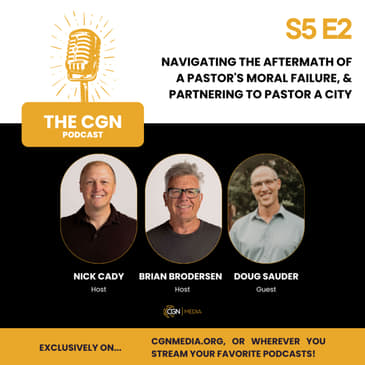


Doug Sauder is the Senior Pastor of Calvary Chapel Fort Lauderdale. In this episode, Doug shares about how he and the church navigated the moral failure of their founding pastor, how the church weathered that storm, and what they learned through the process that other churches can benefit from.
Doug also shares about Church United, a coalition of churches working together in South Florida to reach their community with the Gospel. We discuss how churches can partner together without losing their unique calling and identity.
New episodes will be released every two weeks, on Wednesday mornings. Make sure to subscribe, and new episodes will be delivered to you as soon as they are released.
Register here for the CGN International Conference (June 23-26, 2024)
Send us your feedback on these episodes at CGN@calvarychapel.com
[00:00:00] Hi, Pastor Brian Brodersen here with an invite to the CGN International Conference that is taking place on the campus of Calvary Chapel Coast of Mesa.
[00:00:12] June 23rd through the 26th. We're going to have a fantastic time together.
[00:00:18] Our theme this year is hope, suffering and glory. We're going to be looking at the first epistle of Peter.
[00:00:25] We've got some amazing speakers. We've got nine main sessions. We've got lots and lots of workshops.
[00:00:31] We're going to have panel discussions. We'll have great times of food and fellowship, times of worship and prayer.
[00:00:38] And we would love you to be part of that. So if you'd like to join us, you can get registered at conference.calvarychapel.com
[00:00:49] And the sooner you do that, the better. So come on out and join us for the CGN International Conference June 23rd through the 26th.
[00:00:59] Conference.calvarychapel.com. Look forward to seeing you then.
[00:01:04] People will often say, oh unity is shallow. It's kumbaya. It's not deeply theologically rooted.
[00:01:15] And I'm like, it's the exact opposite. You look at everywhere Satan shows up in the Bible, Revelation chapter 12.
[00:01:20] He divides heaven angels against angels and angels against God. He shows up in Genesis 1.
[00:01:24] He divides people against each other and against God. Everywhere Satan shows up, it's deception, lie, accusation, division.
[00:01:31] That's what he does. So the opposite of that would be unity and love and trust.
[00:01:35] And that means you're fighting against the spiritual forces of darkness to get to unity.
[00:01:39] And we see it in our politics. We see it in our culture. We see ideology, leading theology.
[00:01:45] We see polarization. We all know it. We all feel it, but it's deeply spiritual.
[00:01:50] Welcome to the CGN podcast. My name is Nick Katie. I'm the pastor of Whitefields Community Church in Longmont, Colorado.
[00:02:00] And along with Pastor Brian Brodersen, I will be your host this season.
[00:02:04] The purpose of this podcast is to share with you the stories of what God is doing through Calvary Global Network.
[00:02:11] In this episode, our guest is Doug Sotter, the senior pastor of Calvary Chapel, Fort Lauderdale.
[00:02:17] We talk about what it was like for Doug and the church to navigate the moral failure of their founding pastor
[00:02:23] and how the church was able to weather that storm and what they learned through that process that other churches can glean from.
[00:02:30] We also talk with Doug about a unique initiative in their city called Church United,
[00:02:36] which is a coalition of churches working together to reach their city with the gospel.
[00:02:41] We talk about how churches can partner together without losing their unique calling and identity.
[00:02:47] Here's the episode. Pastor Brian, welcome. Good to have you.
[00:02:54] Well, thank you, Nick. It's good to be together again.
[00:02:57] Hey, Doug. Welcome.
[00:02:59] Hey guys. Good to be with you.
[00:03:01] Well, Doug, we're excited to have you on the podcast.
[00:03:03] Could you just introduce yourself? Tell us a bit about who you are and the ministry that you're involved in.
[00:03:09] My wife, Suzanne and I, we've married 31 years.
[00:03:12] We have three sons born and raised here in Fort Lauderdale and a lead pastor at Calvary Chapel now for the last 10 years
[00:03:20] and really part of the Calvary Chapel for Lauderdale Church and the movement since like 1998.
[00:03:26] So however long that's been, it's been a while.
[00:03:29] So one of the things that is I think interesting about you is that you weren't the founding pastor of the church.
[00:03:35] You've taken over. It's a large ministry and it seems to have been a successful transition.
[00:03:40] So could you share with us a bit about your experience in navigating pastoral transition?
[00:03:47] Yes. Well, we know that a lot of pastoral transitions happen out of scandal and out of controversy.
[00:03:54] It's a lot of challenges.
[00:03:57] You know, you hope for a baton past its smooth and in this case, you know, our founding pastor Bob Coy who had founded the church
[00:04:04] and been there for 28 years with your immoral failure.
[00:04:07] It was sort of a shocking moment for all of us and just wrestling with what do we do?
[00:04:12] And you're trying to pick up the pieces, find out what's happening, processing all this in real time and then and then lead the church forward.
[00:04:19] So on the outside it looks like well, it just kept on going but on the inside, you know, there's all those things that people pray and
[00:04:27] and roll up their sleeves and what boards do and what pastoral teams do and what staffs have to do and how congregations have to heal that are all part of that back story.
[00:04:36] So, yeah, you know, Doug, of course I was there with you in the early days when all that stuff went down and the transition began.
[00:04:47] And I remember, you know, sitting with you and sitting with some of the different board members and it was such a, like you said, it was kind of like an atomic bomb went off in your church.
[00:05:04] And I guess the one thing that I would say though is just the faithfulness of God to build his church despite what happened.
[00:05:17] And I look at the church today and I think that, you know, who could have ever imagined because these kinds of things potentially can just completely destroy a ministry that's happened over and over again.
[00:05:31] But I think you guys are stronger today than ever.
[00:05:36] And that's just a testimony to God's faithfulness and his goodness.
[00:05:42] And I think too, honestly, Doug, I think it's that, you know, the Lord appointed you to lead through that season and into the future.
[00:05:50] And I think having the right man at the helm is really a big part of why the church has gone on to do so well.
[00:05:59] So, so good job.
[00:06:01] Thank you. Staying alive.
[00:06:04] Yeah, I think for me, I think of just the power of Christ to hold his church together.
[00:06:11] You know, Colossians 1-17 is a big scripture for me.
[00:06:14] In him all things hold together and in him all things consist.
[00:06:17] And we felt like Jesus was holding our church together when everything was falling apart.
[00:06:23] And I was actually just looking through that first sermon, those first moments of leading the church through all this transition because people have doubts, fears, anger, shock, denial.
[00:06:33] This what's the future?
[00:06:35] And we were just we were teaching through the Bible and the message was on the unshakable kingdom.
[00:06:40] Everything that can be shaken will be shaken until only the unshakable remains and we're receiving the kingdom that cannot be shaken.
[00:06:47] And so those those sort of grounding principles of the sovereignty of God, of his the promise over his church helped us to heal and to move forward as we process through worship and prayer and getting together and asking for wisdom,
[00:07:02] both from inside leaders and outside leaders.
[00:07:04] And just that whole process, we felt the spiritual covering of God and foundation of God that I was just reminiscing on because this is kind of like the month of the anniversary for us.
[00:07:13] Oh, yeah.
[00:07:14] Right. Yeah.
[00:07:16] And Doug, another thing though, I think is it's really interesting.
[00:07:21] Even though you were on staff and overseeing various ministries, your primary role wasn't teaching the scripture like a senior pastor would do.
[00:07:34] And although you were doing a great job in the area that you were ministering in, it was much different than what you stepped into.
[00:07:44] So how was that adjustment for you?
[00:07:48] Yeah, it was an adjustment.
[00:07:50] I mean, I came to Calvary in 1998.
[00:07:53] I was a public school teacher.
[00:07:54] I work with kids that had been incarcerated.
[00:07:56] So I was used to restraining kids and teaching fractions and math and being a youth pastor at night and leaving basketball camps in the inner city.
[00:08:02] So it was a little rougher, grittier ministry.
[00:08:05] And I came to do foster care.
[00:08:07] I came to help kids mobilize this church and different churches in South Florida to help foster kids find Christian homes.
[00:08:13] So I did my share of speaking in different churches, advocating for vulnerable children.
[00:08:18] But most of my role was organizational.
[00:08:21] Most of it was raising up leaders.
[00:08:23] Most of it was building what would become a nonprofit and then doing family ministry and then eventually leading campuses.
[00:08:29] I was kind of like an executive pastor when all of this happened.
[00:08:32] And so one of the big questions was, are am I called to be a lead pastor?
[00:08:38] And am I ready to be teaching most weekends and that rhythm?
[00:08:44] And that was one of the questions that I had forgotten.
[00:08:47] Yeah.
[00:08:49] And how did you feel like, I mean, could you sense, obviously, the Lord was with you and encouraging you?
[00:08:58] And I remember sitting and initially you were sort of being appointed as the interim pastor.
[00:09:06] Like, okay, Doug's going to take over but we'll kind of see where this goes.
[00:09:11] I remember that specifically.
[00:09:13] But I also remember personally just feeling like, no, I think this is the future.
[00:09:18] But as you stepped in now, remembering that Bob Coy was a massive personality.
[00:09:25] I mean, this is not a guy.
[00:09:29] If you were at a conference and Bob was speaking before you, you're just like, oh great.
[00:09:35] I got to follow this guy.
[00:09:38] He was an amazing communicator and he was hilarious on many levels and then he would just had a way of kind of bringing his point home.
[00:09:48] So this is the guy you're going to follow.
[00:09:51] And you're great on so many levels but your personality's nothing like that.
[00:09:58] Yes, I remember having this conversation with my wife.
[00:10:04] Wives are good at this.
[00:10:06] She looks at me and she says, don't try to be funny.
[00:10:09] Just be yourself.
[00:10:11] And I was like, huh, is that funny?
[00:10:15] And I knew what she was saying.
[00:10:17] Like just be yourself.
[00:10:18] I mean, God has picked you.
[00:10:20] You're not the same.
[00:10:21] So just you be the best version of you.
[00:10:23] You're a vessel filled with the Holy Spirit.
[00:10:25] God's going to work.
[00:10:26] So that was free.
[00:10:29] Yeah.
[00:10:30] And so as you stepped into that pulpit on that first Sunday, that was going to be the beginning of an entirely new season that is now 10 years have gone by.
[00:10:39] Did you sense like some sort of fresh empowering from the Lord?
[00:10:46] I mean, you know, was there any subjective aspect to it that you felt?
[00:10:51] Yeah, I think there were like three moments for me.
[00:10:54] The first moment was just like, this is such a surreal experience.
[00:10:59] Like what am I doing up here?
[00:11:01] And what do I have to say?
[00:11:04] And part of that was just the first two weeks where you're in shock.
[00:11:07] You're sort of numb because you haven't slept.
[00:11:09] You've been having these conversations.
[00:11:10] You're considering this call, whether you're going to say yes or no, how it's going to affect your family, your kids.
[00:11:15] So you're sort of in like this wah-wah kind of place.
[00:11:18] But feeling like you're being carried by the spirit of God because you don't know what to think or feel.
[00:11:24] The second moment was the first Christmas where we're lighting candles and you got thousands of people with candles and you're singing Happy Birthday to Jesus.
[00:11:30] And we've done that for 15 years and we were in the congregation and now we're leading it.
[00:11:36] And my wife and I sort of looked at each other like, this is the weirdest experience, I think, ever.
[00:11:43] And then it was probably a year, probably a year in, maybe a year and a half in.
[00:11:47] I literally remember like as I'm preaching like the Holy Spirit just saying to me, these are your people.
[00:11:56] Because I think for the year and a half I felt like I was babysitting or I was taking care of someone else's flock or congregation.
[00:12:02] And I think it took a while for God to say, you're the leader now so lead and these are your people and you are their spiritual father.
[00:12:12] And so it literally happened while I was preaching. I don't know how else to describe it.
[00:12:16] Sometimes the Holy Spirit just shows you something that you need to know.
[00:12:19] And I think it was part of a question that I hadn't even really thought deeply about.
[00:12:22] But from that moment on, I believed it.
[00:12:26] Yeah, that's great. I love that.
[00:12:30] You know, on a similar kind of a note obviously when I became the pastor here at Calvary Chapel Coast of Mesa after Pastor Chuck's long, long season of pretty much founding and pastoring the church.
[00:12:45] People would ask me like, wow, how are you going to fill Chuck's shoes?
[00:12:50] And I just would say I have no intention of trying to fill Chuck's shoes.
[00:12:54] No way to do that.
[00:12:55] I'm not going to let Chuck take care of the rest.
[00:12:58] I'm just going to be who I am and let God take care of the rest.
[00:13:03] Absolutely.
[00:13:04] That's the only way to do it.
[00:13:06] One of the articles I read in the first week or two was that we're all interim pastors.
[00:13:10] We all pick up a baton and we all pass a baton.
[00:13:13] So that's very freeing to be able to go.
[00:13:16] I'm going to run my course and I'm going to pass this on and the church is bigger than me.
[00:13:21] But I have a role to play so let me just play it well.
[00:13:24] Yeah.
[00:13:25] Yeah.
[00:13:26] Cool.
[00:13:27] That's great.
[00:13:28] And how did the church weather that whole entire event with Bob's failure and departure
[00:13:32] and then a new pastor coming on?
[00:13:34] How did that go for the congregation?
[00:13:36] Yeah, I think the same way God heals people, God heals churches.
[00:13:42] And he healed us through corporate prayer, corporate worship and lots of conversations.
[00:13:48] I think every conversation I had the first month was like an hour long.
[00:13:52] It started off with anger, suspicion, fear, sadness, despair, searching and groping for questions
[00:13:58] all the wise.
[00:13:59] If Bob didn't make it, am I going to make it?
[00:14:01] I mean we did a marriage conference like six months later at like 6,000 people at the conference
[00:14:06] because there was just like a...
[00:14:08] It brought up all the issues in everyone else's life.
[00:14:10] Like well if he was keeping this away from people, are you keeping this away from people?
[00:14:15] And everyone sort of looks sideways at each other.
[00:14:17] This is the first time I think our church in our region had such a big sort of scandal
[00:14:22] or betrayal that was...
[00:14:23] And this is the biggest church in this community.
[00:14:25] So, and Bob was a spiritual father to people who sort of cycled in and out of this church.
[00:14:30] So we had to go through all those stages of grief processing and I had people that would show up
[00:14:38] six months, nine months a year after and said, you know, I haven't been back since the announcement was made
[00:14:43] but now I'm back.
[00:14:44] I just had to wrestle on this out with God, but now I'm back.
[00:14:48] But also the reality is, you know, we lost about 20% of our congregation and our giving like in a week.
[00:14:54] It just evaporated.
[00:14:55] And so we're also dealing with staffing issues and financial issues and halting building projects
[00:15:02] and figuring out what is the core of what we do to make disciples and fulfill our mission
[00:15:06] and how do we make these organizational decisions?
[00:15:09] So there was a lot of that as well.
[00:15:12] So, but God was faithful to bring insiders and outsiders to advise us and just provide wise counsel and support,
[00:15:20] especially through that first year.
[00:15:23] So thinking back on how you handled the transition, is there anything that you think,
[00:15:28] you know, for other people listening, I'm sure many of them might be going through transitions,
[00:15:32] whether forced or planned?
[00:15:34] Are there any things that you think were particularly effective that you would give us advice?
[00:15:38] And are there any things that you look back on and you kind of wish that you had done them differently?
[00:15:43] Yeah, I think the biggest question for a church is, you know, what kind of governance do you have set up?
[00:15:51] I mean, when the lead pastor or the senior pastor is removed or resigns,
[00:15:55] then now the board has the decision to find that next leader.
[00:15:58] And is that clear?
[00:16:00] Is it established?
[00:16:01] I mean, for us, it actually only really got established significantly like six months before
[00:16:06] as a leader came in to help with succession planning and realized the way they formed this church when it started
[00:16:11] wasn't sufficient to deal with what it was today.
[00:16:14] And so, thankfully that did take place.
[00:16:17] So there was clarity on who's going to make the decision and how it's going to be made.
[00:16:20] And a lot of churches are not prepared for that moment.
[00:16:23] And I think the greatest loss of momentum in the Christian church is just the bad handoff from one church to,
[00:16:29] you know, from one leader to the next, where they lose all the people, all the momentum,
[00:16:33] because a leader hangs on too long or doesn't raise up another leader because they feel threatened.
[00:16:38] And so the church has to start all over again.
[00:16:40] And so I think that's something that we've paid a lot of attention to.
[00:16:45] We want every one of our leaders, no matter where they serve to have a succession plan,
[00:16:49] who's the person you're raising up if you take another job or you're promoted
[00:16:53] so that your area doesn't lose momentum.
[00:16:55] It's that intentional, you know, second Timothy,
[00:16:58] you're entrusting what you've heard to reliable leaders who are faithful to raise up new leaders
[00:17:03] and it's that empower leaders value that I think is so important.
[00:17:08] I think the other thing I learned was our staff, the people closest to the blast,
[00:17:13] to the pain, to the trauma needed the most care.
[00:17:17] And so our congregation was hurt but not as much as our staff and not as much as the leadership team.
[00:17:22] So the closer you got, the harder it was.
[00:17:26] And so we went on a year long process of asking what kind of church staff culture do we want to have here?
[00:17:35] Because we had hundreds of staff people.
[00:17:37] So it's like a church in itself.
[00:17:39] How do we want to treat each other?
[00:17:40] And it's interesting that I wanted to create those values right away.
[00:17:44] We need to reset the values and I got some wise counsel from a leader who said,
[00:17:48] let the people pick the values.
[00:17:49] What do they want?
[00:17:51] And so over a year, we picked seven values and the first one was humility.
[00:17:56] That people wanted leaders who were humble and didn't use I, me, my all the time but we us our.
[00:18:02] And so those values began to trickle and change the way our staff interacted with each other
[00:18:07] and really helped us to frame what type of staff people we were going to keep on
[00:18:12] and what type of people were going to hire in the future.
[00:18:15] And so that was a huge part of the process.
[00:18:17] And I think if I could do anything different, I would have let those values speak more loudly,
[00:18:23] more clearly for people who didn't want to embrace the new value system and made quicker decisions on saying,
[00:18:28] hey, you know, here's where you're at.
[00:18:30] Here's the new value system.
[00:18:31] It's probably a better match for you to find another organization where your values match their values.
[00:18:37] So yeah, you know, it's interesting that you that you guys had at the top of your list humility.
[00:18:44] I was in a conversation kind of a panel discussion yesterday on longevity and ministry.
[00:18:51] So what's a key to longevity?
[00:18:53] And I was alongside of Bishop Kenneth Olmer, who's very well known in the African American community
[00:19:00] and pastored a large church in Los Angeles for years.
[00:19:03] So anyway, so they asked the Bishop the question and he went right to humility.
[00:19:10] And I turned to the person next to me and I opened my little notebook and I showed him my point number one.
[00:19:16] And my point number one, my number one point was humility.
[00:19:20] And I just think, you know, I mean, this is really it's foundational without, you know, God resist the proud,
[00:19:27] but he gives grace to the humble.
[00:19:30] And how, how is it that so often in ministry, we forget that, you know,
[00:19:36] and I think a case in point, of course, would be Bob.
[00:19:40] And you know the, I remember he started off humbly because I had conversations with him back in those early days when he was trying to figure out what he was doing.
[00:19:49] But like so often is the case and certainly he's not the only person that this has ever happened with,
[00:19:56] but success can get to your head.
[00:19:59] And pretty soon that humility that you started with is is gone.
[00:20:04] So, you know, one of the things that I've been curious about and I've heard other people say this is why is it that so many of these large or maybe at least seems like so many pastors of large churches or high profile Christian leaders have these moral failures?
[00:20:22] Is there something that is common amongst them?
[00:20:25] Is there something that perhaps happens as a church grows?
[00:20:28] I know in our own church, you know, we grew over the last couple of years and one of our elders brought up this point.
[00:20:35] Well, how do we keep this from happening in our church because we don't want that?
[00:20:39] You know, and so Doug, do you have any thoughts about that?
[00:20:43] Yeah, we're actually sitting with, I think Mark DeMoss as his name.
[00:20:46] Yeah.
[00:20:47] He basically wrote the Little Red Book of Wisdom and he had like nine factors.
[00:20:50] He met with a bunch of pastors in our city and just talking about that same thing because he's worked with the Billy Graham Association and the Ravi Zachariah Ministries and crew and all the big ministries around some of these break downs.
[00:21:01] It's like there's, you know, the biggest factor is just the issue of pride.
[00:21:05] Pride is the thing that begins to make you think you're different so that all the rules or all the safeguards are guardrails that you apply to everyone else don't apply to you.
[00:21:15] And he used, you know, Arabis as an example, you know, their evangelists would have to take, you know, could only have eight travel days, you know, a month because they need to spend time with their wife and their kids and their family and stay grounded.
[00:21:25] But he traveled, you know, 280 to 300 days a year.
[00:21:28] And so the things that apply to everyone else didn't apply to him.
[00:21:31] And so you sort of go, well, that's the leader.
[00:21:34] And he's saying if you're the leader, you have to model the values you want people to take.
[00:21:39] And so don't make yourself an exception.
[00:21:42] Don't create entitlements for yourself or the kind of I deserve that when you handle so much pressure and you handle so much criticism, you're looking for some kind of relief, some kind of escape.
[00:21:55] And if you don't find that in the Lord or in healthy relationships with your wife or your kids, you're going to find it in alcohol or drugs or sex or some, you know, nefarious way.
[00:22:05] And you're going to justify it.
[00:22:07] And so, and honestly, I don't think it's just, you know, big churches.
[00:22:12] I think I think it I've seen so many pastors of small churches.
[00:22:17] It's amazing how human pride, whether you have 50 people following you or 500,000 people following you can work its way out in your life.
[00:22:25] And so those safeguards are important no matter how big your church is.
[00:22:31] Yeah, that is so absolutely true.
[00:22:33] I actually said that almost verbatim yesterday because you tend to think that that it well, it's just a mega church problem.
[00:22:41] But no, it's just a human problem.
[00:22:44] It is a human problem.
[00:22:45] It's a matter of the heart.
[00:22:47] Yeah.
[00:22:48] And so kind of final question on this topic before we shift to something else is, you know, as CGN as a network of churches, what was the role that having a network of churches provided for Calvary Fort Lauderdale in this process?
[00:23:03] Was it helpful and NDC value in it?
[00:23:07] Yeah.
[00:23:08] I mean, having a network is vitally important.
[00:23:10] So for us, our network was actually a whole bunch of local churches that we had been working with in the city for a while.
[00:23:17] We'd done common foster care initiatives together.
[00:23:20] We'd done common basically business leader training.
[00:23:24] So we've had a really healthy ecosystem of what can we do as churches together?
[00:23:30] So when we experience our difficulty, all the pastors in the city gathered together to pray for us and pastors showed up.
[00:23:38] Their congregations showed up bringing food.
[00:23:40] We got cards from different congregations.
[00:23:42] They offered to help in any way possible.
[00:23:45] And so there's some local nonprofit leaders who came and sat with our board and gave us advice.
[00:23:50] So we had people within the Calvary Network and then outside the Calvary Network who all sort of helped lean in just to be a sounding board.
[00:23:56] Are we thinking correctly about this?
[00:23:58] About that.
[00:23:59] I mean, the first thing my wife and I did when they asked us was go to meet with one of those leaders who doesn't go to our church and just said, you know, is it possible to lead a mega church and have a healthy marriage?
[00:24:09] That was my wife's, you know, litmus test for us stepping into this role.
[00:24:13] If we can't, if this destroys our marriage and family, then no, it's a no.
[00:24:17] And we got some great advice from an outside leader and his perspective of knowing all the pastors in the city for the last 30 years and being sort of that counselor, that sage who would advise and counsel.
[00:24:30] So I would say if you ever try to do this alone, you're going to make a lot of mistakes and you're going to feel very lonely and isolated.
[00:24:37] That's why God builds community around people so they don't have to do this alone.
[00:24:43] I think that's pretty extraordinary, though, just what you described about what happened.
[00:24:48] I mean, so often you see kind of the opposite almost like when a, especially, you know, a mega church, somebody falls sad to say, I mean, a lot of people are like, oh yeah, I could see it come and they deserved it, you know, kind of kick them to the curb and maybe my church can become the most important church in the city now.
[00:25:06] You know, it's like.
[00:25:08] Yeah, we literally had pastors who basically said if you the weekend after the two weekends after if you've left Calvary to come here and go back to your home church, they need you.
[00:25:15] And that's extraordinary.
[00:25:17] That is extraordinary.
[00:25:19] In fact, in fact, we one of the most random beautiful things was we got a box of cards from some church in New Mexico that we had never heard of before not part of the Calvary tribe just they heard that we went through a scandal they sent us a box of handwritten cards like 500 handwritten cards.
[00:25:34] And the letter basically said we went through this three years ago and we want you to know you're going to make it.
[00:25:39] And so we just passed out cards to every staff person.
[00:25:42] That was like one of the most beautiful just moments.
[00:25:45] And so, you know, when we find out churches go through this that's part of our tradition as well just because it was so touching to us in that moment.
[00:25:53] That's extraordinary.
[00:25:54] That's amazing really.
[00:25:55] I mean, you know, church, you never you don't even know and they hear about it.
[00:26:01] That is so beautiful.
[00:26:02] That is that's the body of Christ, the way the Bible describes it, the way the Lord intended it to be.
[00:26:09] Yeah, and I'd love to hear more about that Doug.
[00:26:11] So like what has been your and the church's approach to working with other churches in your community?
[00:26:17] And I know you have this concept of like pastoring the city and I'd love for you to share about that.
[00:26:23] Yeah, when I stepped into this role, one of the questions was, you know, how do you how do you distribute a mega church?
[00:26:29] How do you not make it about one person, one personality?
[00:26:32] How do you make it more distributed in the whole city?
[00:26:35] Because a lot of mega churches start with we don't have enough seats and parking at this location.
[00:26:39] Let's create satellites where people don't have to drive all the way but can get the same experience versus asking the question.
[00:26:45] What is that part of the city need?
[00:26:47] And how is that context of different and how do we how do we reach the city that way?
[00:26:51] In that conversation, we began to see what we would accomplish through foster care.
[00:26:56] So I came in 2000 to help build a network of Christian churches where we would go and it was not uncommon for me to teach at a Baptist church or a Presbyterian church and say,
[00:27:06] this is God's heart for the orphan and we have all these kids in our city and they can find foster and adoptive homes and they can be served so come and serve.
[00:27:13] So this network of 200 churches was mobilized to meet a need and a lot of cities have this.
[00:27:19] A lot of cities will, whether it's their pro-life ministry, their pregnancy center counseling center or whether it's a homeless ministry,
[00:27:27] whether it's a home to raise up young men to be men in a godly environment.
[00:27:33] We do this really well in the prayer church space but we do it horribly in the church space.
[00:27:36] And so we just started asking what about if we did this in a church space?
[00:27:40] What could we do together that we couldn't do on our own?
[00:27:43] And it just so happened that we had a major transition at the largest four or five churches in our city,
[00:27:49] the largest Baptist church, the largest Presbyterian church, the largest Assemblies of God church.
[00:27:54] Our church had all gone through transitions from founders and high dynamic personalities to sort of unknown leaders who were like,
[00:28:03] what if it wasn't about us but it was about something we could build?
[00:28:07] And so we just started pursuing the question, what could we do together that we couldn't do on our own?
[00:28:11] And that started to lead us down a road of praying together and coming up with common initiatives and just doing life together.
[00:28:18] And now, frankly, a lot of us are best friends.
[00:28:21] Gosh, that...
[00:28:24] And again, that's pretty extraordinary.
[00:28:27] When I'm talking to people about unity in a community with churches,
[00:28:32] you're the first example that I go to because I just think what you guys have been able to be part of there is...
[00:28:40] It's pretty unheard of, I think.
[00:28:45] You know, usually there's so much competition between churches.
[00:28:48] There's, it's territorialism, those kinds of things happening even within our own tribe, you get that sort of thing.
[00:28:56] But for you guys to have such a radical diversity of churches, denominations and saying,
[00:29:05] hey, let's take the city for Jesus.
[00:29:08] Let's be a witness in this community.
[00:29:11] Man, now what is it?
[00:29:13] Is it like 61 churches or something that...
[00:29:16] I remember at some point it was something like that but maybe it's...
[00:29:19] Yeah, we've got a core group of leadership churches, about 50 of those churches.
[00:29:23] Then we have like, you know, there's a different levels of commitment.
[00:29:27] We do a common teaching series every November where we write curriculum together and teach the same series.
[00:29:31] We have a common night of worship that we gather all the churches and worship teams together.
[00:29:35] We have worship collectives and worship leaders from different churches that meet together.
[00:29:39] We do the same with youth pastors, executive pastors, lead pastors.
[00:29:42] And we do a lot of soul care.
[00:29:44] We have a fund to take to send a pastor and his wife on vacation or to pay for counseling if they're burnt out
[00:29:50] or by vocational pastors to put tires in their car or put an air conditioning in their church.
[00:29:54] So we have donors that help us in this entire system of going,
[00:29:57] we want to create the type of ecosystem where healthy leaders will lead healthy churches,
[00:30:02] which will lead to a flourishing city.
[00:30:04] And so we've sort of gone all in on those things.
[00:30:07] And we look at it like we're pastoring the city.
[00:30:09] I'm not just pastoring Calvary or our campuses.
[00:30:12] I'm pastoring the city.
[00:30:14] And one of the men who gave us a vision for this was a man named Tim Hawks.
[00:30:18] He was from Austin, Texas.
[00:30:20] And Austin had been in this experiment for a while and he basically said,
[00:30:25] there was a tsunami in the early 2000s and basically the city of Austin,
[00:30:30] I think collected like $50,000 and it was like front page news.
[00:30:34] So he was so curious.
[00:30:35] So he called all of his other pastor friends and realized that all the churches of Austin
[00:30:38] had collected over $200,000 for the tsunami,
[00:30:40] but they had no way to voice it what we did together.
[00:30:43] And so he was like in this city where, you know, this sort of pagan ideology
[00:30:48] trumps, you know, the Christian church and people aren't even aware of what the church does
[00:30:53] because they have no voice.
[00:30:54] They have no way, common way to communicate.
[00:30:56] And that was the moment for him.
[00:30:58] And so we gathered some people and said, hey, we want to tie their time to the city.
[00:31:02] And so every pastor I meet with, I'm just like, hey, would you tie their time to the city?
[00:31:06] 90% of your time, pastor, your church, but 10% of the time, meet with other pastors,
[00:31:11] meet with the mayor, meet with the police chief.
[00:31:13] Let's work together on reaching this, the lost broken people of the city with the gospel of Jesus Christ
[00:31:19] and people catch that vision because it's a New Testament gospel vision.
[00:31:23] Yeah.
[00:31:24] Is it, I mean, it's obviously developed over time.
[00:31:29] It just didn't pop up out of nowhere.
[00:31:32] Has there been resistance to it?
[00:31:35] Yeah, no, it's been so easy, Brian.
[00:31:38] It's just like a trend.
[00:31:39] It's like the transition.
[00:31:40] It's been so easy.
[00:31:41] Because I'm finding unity is the most challenging thing to champion.
[00:31:48] Yeah.
[00:31:49] You know, it just seems almost impossible.
[00:31:52] Yeah.
[00:31:53] And so one of the questions that we should be curious about is why is it so hard?
[00:31:57] You know, because people will often say, oh, unity is shallow.
[00:32:00] It's kumbaya.
[00:32:01] It's not deeply theologically rooted.
[00:32:02] And I'm like, it's the exact opposite.
[00:32:04] You look at everywhere Satan shows up in the Bible, Revelation chapter 12.
[00:32:07] He divides heaven angels against angels and angels against God.
[00:32:11] He shows up in Genesis one.
[00:32:12] He divides people against each other and against God everywhere Satan shows up.
[00:32:16] It's deception, lie, accusation, division.
[00:32:18] That's what he does.
[00:32:19] So the opposite of that would be unity and love and trust.
[00:32:22] And that means you're fighting against the spiritual forces of darkness to get to unity.
[00:32:27] And we see it in our politics.
[00:32:29] We see it in our culture.
[00:32:30] We see ideology, leading theology.
[00:32:33] We see polarization.
[00:32:34] We all know it.
[00:32:35] We all feel it, but it's deeply spiritual, which means that unity is not uniformity.
[00:32:40] Getting together in your little tribes, everyone who looks like and thinks alike and believes all the same stuff.
[00:32:44] That's easy to do.
[00:32:45] Gospel unity is Greek and Jew and slave and free and male and female.
[00:32:50] And the more diverse that group is, the more spiritual that unity is the deeper it is because it has to be strong enough to overcome all that idolatry and all of those things that would naturally take us apart.
[00:33:03] So the more diverse you have that unity, the more criticism you're going to get.
[00:33:08] And we've gotten plenty of that.
[00:33:12] And how do you do that?
[00:33:13] I mean, how do you maintain your own unique identity and your own mission while at the same time working together?
[00:33:21] I mean, what are their limitations to that working together?
[00:33:25] What does that look like in practice?
[00:33:26] And how do you keep from losing your identity in the midst of it?
[00:33:31] Yeah, and that's a great question.
[00:33:33] That's people's biggest fear.
[00:33:35] So I'll say this.
[00:33:36] It's possible to value theology, hate sin, and pursue biblical unity at the same time.
[00:33:41] And if you can believe those three things, then you can move forward in pursuing gospel unity.
[00:33:47] So yeah, so I think we maintain our distinctiveness as a Calvary Chapel.
[00:33:53] Here's what we believe.
[00:33:54] We haven't changed one of our distinctive beliefs.
[00:33:57] But as I listen to other pastors around what we call like right-handed, essential doctrines versus distinctive doctrines,
[00:34:04] I could go, you know, I don't see it that way.
[00:34:06] I don't agree with how you're processing that second hand or left-handed doctrine.
[00:34:10] But because of your faith in Jesus Christ, you're going to be in heaven.
[00:34:13] You're my brother.
[00:34:14] We have the same gospel mandate.
[00:34:15] So we're not going to argue about how we baptize or how the Holy Spirit works in and through us or exactly when and how Jesus is going to come back.
[00:34:22] That's not going to help us reach our unlost neighbor, friend or coworker.
[00:34:25] Let's focus on how do we bring the gospel to them in a way that builds this curiosity or aroma?
[00:34:31] And so one of the things we've done is we've come up with a common evangelistic outreach.
[00:34:36] We use Alpha.
[00:34:37] So we send all of our pastors to London.
[00:34:41] They go to HBT and we listen to Nicky Gumbel talk about like how do we create this collective evangelistic thing?
[00:34:47] And then we go back and so you can go to different parts of the city and all see Alpha is for the curiosity seeking person to come to Jesus.
[00:34:54] And we'll send people to different churches so they can come to know Jesus.
[00:34:58] And if they end up coming to our church, they're going to hear a little bit of a distinctive doctrine differently than the church down the street.
[00:35:04] And that's okay.
[00:35:06] That's sort of how we're pursuing that.
[00:35:09] But actually something really cool by the way is a...
[00:35:12] So I'll tell you about a dinner I had with a charismatic guy, assembly of God guy and a Presbyterian guy.
[00:35:17] So we're having dinner with our wives and we're talking about church United.
[00:35:20] We've been friends for years.
[00:35:21] We've done foster care.
[00:35:23] We've done evangelism.
[00:35:24] And so one of them is like, okay, we have some people that want to get baptized that are adults.
[00:35:30] How do you guys do baptism for adults?
[00:35:32] I'm like, oh, that's easy.
[00:35:33] So we...
[00:35:34] They went to the beach and we experienced this baptism moment where they're baptizing adults.
[00:35:39] I just got saved.
[00:35:40] They can't sprinkle them as babies because they're adults and they're experiencing this because they're learning from us.
[00:35:45] And then how do you pray for people and annoying them with oil after a service?
[00:35:49] We've never done that before.
[00:35:50] Oh, let us tell you.
[00:35:51] And then I asked them a question.
[00:35:53] Hey, tell us about the Apostles Creed.
[00:35:55] Tell us about the confessions of the church.
[00:35:56] How do you do that?
[00:35:57] And they're teaching us.
[00:35:58] And so we're taking the best of our Christian traditions and we're bringing them together and we're becoming better as a fuller expression of the body of Christ through those interactions.
[00:36:09] And again, it doesn't mean you agree with everything, but you don't agree with your wife on everything or your kids on everything.
[00:36:14] You still have Thanksgiving dinner with them and you're still family and the church is the same thing.
[00:36:19] Yeah.
[00:36:20] Gosh, that's beautiful.
[00:36:21] I love that.
[00:36:23] So is Church United...
[00:36:24] That's the name of it?
[00:36:26] Is it like its own entity?
[00:36:28] Is it an informal thing?
[00:36:30] Does there a leader to it?
[00:36:32] Yeah.
[00:36:33] So if you're looking for change movements and best practices across the country, Stanford University has five kind of markers of what's going to bring movement to a city.
[00:36:47] So the first one is you're coming up with sort of like a back office, like a centralized organization.
[00:36:53] So we had three or four churches that all invested some money.
[00:36:56] We created a nonprofit under the National Christian Foundation.
[00:37:00] We hired an executive director whose number one job is to align all these things for us to fulfill our mission and vision because I'm a pastor.
[00:37:06] If I gave 10% of my time, we would never move the needle.
[00:37:09] But so we have a full-time pastor who's working with all these other pastors in a central office with its own stated goals that we as the church leaders come together to form.
[00:37:20] So we have our clear vision, our clear mission and that leader is working on goals and events and initiatives to make those things happen.
[00:37:27] So shared communications, shared measurements, those are the type of things that help formalize this because if it's just an idea, it'll be like a lot of other things.
[00:37:37] You'll get together, have some great prayer moments, some great worship moments, a couple of great outraches, and then it'll just fade.
[00:37:43] But we have people stoking the fire every day of the week to keep it moving forward.
[00:37:48] Wow.
[00:37:49] That's amazing.
[00:37:50] Are you aware, Doug, of any other city where something similar is happening?
[00:37:57] Yeah, there's a lot of great different movements, different levels of organization.
[00:38:02] There's a great movement in Charlotte, one in Austin, one in the Bay Area, different levels of financial support, different leadership models.
[00:38:10] And so we're constantly learning.
[00:38:12] There's a great one in New York.
[00:38:13] So we're constantly going and learning and taking the best of what other cities have done to inform ours.
[00:38:20] But I think of all the leaders I've talked to, we've got the best relational equity, the best trust equity, and that takes time to build.
[00:38:29] You can't form an organization and build trust.
[00:38:31] Trust building takes years and decades.
[00:38:34] And we've had leaders in our city who have formed that DNA of build trusting relationships and speak in the lives of other leaders.
[00:38:43] And that takes time.
[00:38:46] How do you even start that?
[00:38:50] Yeah, you started with a conversation.
[00:38:52] I mean, the reality is everyone can do something.
[00:38:54] So if you're a pastor, you could just realize that you've been driving past the church that's a mile from your house or a mile from your church.
[00:39:01] And you never met the pastor.
[00:39:02] And it's like, hey, can we have a cup of coffee?
[00:39:04] And we call this like the coalition of the willing.
[00:39:06] Not everyone's willing to have a cup of coffee and have a conversation, but there are people who are.
[00:39:10] And just if you start to pray together and talk about your common vision to reach the city, you might decide, hey, we do turkeys on Thanksgiving.
[00:39:17] And so do you.
[00:39:18] What if we did that together and gave our people a taste of that?
[00:39:21] Hey, what if we did a Good Friday service together because you don't have a building and we do?
[00:39:25] These are all these kind of moments where most people like I'm all alone.
[00:39:29] I don't know what to do and God's provided you people all around you who are asking the exact same questions.
[00:39:34] And it's just a matter of, you know, what can we do together that we can't do on our own?
[00:39:38] Yeah.
[00:39:39] Wow.
[00:39:40] So somebody the other day was asking me if I thought there was, you know, sort of one more great Jesus movement moment that that's coming.
[00:39:52] And I said, well, you know, obviously I sure hope there's something like that.
[00:39:57] I said, but you know, I think we need to also recognize that sometimes that happens on a smaller scale that might happen in just it might be a regional awakening where God just does something extraordinary in a community that doesn't necessarily migrate to another place.
[00:40:18] It might, but it might just be this is the place where this kind of stuff is happening.
[00:40:22] And I have always felt like there's some unique sort of working of God's spirit in your area for this kind of stuff to happen.
[00:40:33] And one of the things that makes me think that is just the massive numbers of people that have come to faith through your ministry there.
[00:40:41] You know, I have met people all over the world who tell me their story about how they somehow made it into Calvary Chapel Fort Lauderdale.
[00:40:50] And that's how they met Jesus.
[00:40:52] And now they're living in the jungle somewhere and preaching the gospel to unreached people.
[00:41:00] That's not an exaggeration.
[00:41:02] That's a reality.
[00:41:03] So do you think that there's something to that that you guys have been in?
[00:41:09] I mean, you know, you and I know each other pretty well.
[00:41:12] We've been in some big cities together.
[00:41:14] You know, I don't remember any of the, you know, Chicago, New York places.
[00:41:17] I don't remember the scent in any of those places.
[00:41:20] Like there's some, wow, there's like some real radical church movement going on here.
[00:41:25] So what do you think about that?
[00:41:27] Yeah, I mean we talk about this all the time.
[00:41:29] We like, God, if we don't want to read about revivals that happen and we want to see them with our own eyes.
[00:41:34] And so I, you know, we always use the phrase a thousand brush fires.
[00:41:38] Like it might not, it's not going to be one big fire.
[00:41:41] It might not be one big fire.
[00:41:42] Maybe a thousand brush fires that come together.
[00:41:44] And so we want that to happen here.
[00:41:46] You know, I just, I love South Florida because it's so diverse.
[00:41:50] Like our county is like a third white, a third black, a third Hispanic.
[00:41:53] We have people from everywhere.
[00:41:55] You don't even know where people are from or what language they're going to speak.
[00:41:58] And so it's such a diverse environment that no one seems to belong and everyone belongs.
[00:42:04] And that's a picture of the church.
[00:42:06] It's a picture of the future church in Revelation, every tribe, Tang nation language.
[00:42:09] And so there's not a huge resistance around having conversations around the gospel.
[00:42:14] You know, it still can be a very liberal or progressive society, but it's not closed in conversation like some other cities are.
[00:42:25] So there's a lot of opportunity every weekend we make an invitation, people respond.
[00:42:29] And so people are inviting their friends and family and we're watching this not just in our church, but in other churches.
[00:42:35] And there's a huge Hispanic network of churches here that have, and many healthy, healthy churches that are evangelistic in nature
[00:42:44] and the gospels being preached and people are being saved.
[00:42:46] So we continue to pray God, we want to see it with our own eyes and we want to see it here.
[00:42:50] So that's our prayer.
[00:42:52] Okay, well pray that for us too.
[00:42:54] Okay.
[00:42:55] Pray that for Nick.
[00:42:56] Yeah.
[00:42:57] We want to see it too.
[00:42:58] Absolutely.
[00:42:59] I think we all want to see it.
[00:43:00] We all want to see it.
[00:43:02] That's great.
[00:43:03] Well, hey Doug, thank you so much for sharing these things with us.
[00:43:06] And if people want to find out more about you or your ministry, is there a place where they can do that online?
[00:43:11] Sure.
[00:43:12] It's CalvaryFTL.org.
[00:43:14] Awesome.
[00:43:15] Thanks so much, Doug.
[00:43:16] Thanks, Nick.
[00:43:17] Thanks, Brian.
[00:43:18] Great talking to you.
[00:43:19] Thanks for listening to this episode of the CGN podcast.
[00:43:24] In our next episode, we will be speaking with pastor and theologian Dan Kimball.
[00:43:29] So make sure to subscribe to the podcast so you will receive that episode as soon as it comes out.
[00:43:34] New episodes are released every two weeks and we'd love to hear your feedback on these episodes
[00:43:39] so you can email us at cgn at CalvaryChapel.com.
[00:43:44] If you'd like to support this podcast, one of the best ways to do that is by sharing this episode with someone else
[00:43:49] and giving us a rating and review on your favorite podcast app.
[00:43:53] Until next time, God bless you.
Sponsors