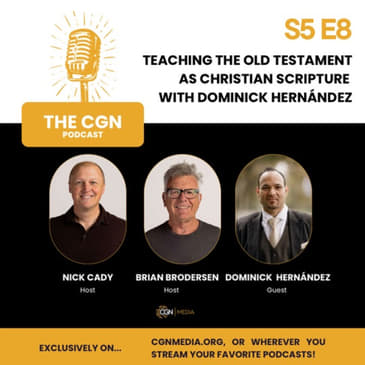


As a Calvary Chapel network, CGN values biblical literacy. Calvary Chapel has a long history of teaching the entire Bible in an expositional way, and in this episode, Pastor Brian Brodersen and Nick Cady speak with Dr. Dominick Hernández, Associate Professor of Old Testament and Semitics at Talbot School of Theology.
Dr. Hernández has a long history with Calvary Chapel, and in this discussion he talks about teaching the Old Testament as Christian scripture, including discussions about the best ways to teach the Old Testament, good and bad methods of teaching Christ in all of Scripture, and how to understand the opening chapters of Genesis.
For further study, check out Dominick's book, Engaging the Old Testament: How to Read Biblical Narrative, Poetry, and Prophecy Well
[00:00:01] The first half of your sermon, or the first half of your teaching about these old texts, needs to jive in the synagogue.
[00:00:07] People need to get what you're talking about when you speak about texts in their contexts.
[00:00:11] We can't talk about Leviticus and not talk about Moses and the people of Israel.
[00:00:15] But then we are privileged enough to see how Christ has fulfilled these passages in who He was, who He is, and what He did on the earth.
[00:00:29] Welcome to the CGN Podcast. My name is Nick Cady, and along with Pastor Brian Broderson, I will be your host this season.
[00:00:36] As a Calvary Chapel network, CGN values biblical literacy.
[00:00:41] Calvary Chapel has a long history of teaching the entire Bible in an expositional way.
[00:00:47] And in this episode, Pastor Brian and I speak with Dr. Dominick Hernández.
[00:00:51] Dominick is the Associate Professor of Old Testament and Semetics at Talbot School of Theology.
[00:00:57] He has a long history with Calvary Chapel, having attended the Calvary Chapel School of Ministry, and having served on staff at a Calvary Chapel church.
[00:01:06] In this discussion, Dominick talks about teaching the Old Testament as Christian scripture, including a discussion of the best ways to teach the Old Testament,
[00:01:16] good and bad methods of preaching Christ in all of scripture, and how to understand the opening chapters of Genesis.
[00:01:23] Dominick also recommends some resources for those wanting to deepen their understanding of the Old Testament.
[00:01:29] It's a fascinating discussion. I hope you'll enjoy it. Here's the episode.
[00:01:37] Dominick, thanks so much for being a guest on the CGN Podcast today.
[00:01:41] It's delightful to be on with you gentlemen.
[00:01:44] Pastor Brian, welcome.
[00:01:46] Yeah, thanks Nick. Good to see you and good to see Dominick.
[00:01:50] Well, Dominick, could you share with our audience just a bit about yourself, who you are, and how you came to this point where you're at today?
[00:01:56] My name is Dominick Hernández. I serve as a professor of Old Testament Semitics at Talbot School of Theology,
[00:02:02] which is the School of Theology of Biola University in La Mirada, California.
[00:02:06] I'm also the director of Talbot en Español, which is the Spanish language department, I guess you could say, of Talbot School of Theology,
[00:02:13] where we offer three master's degrees and a certificate program all at the graduate level.
[00:02:17] I studied Hebrew Bible, Old Testament throughout my doctoral studies.
[00:02:23] So I have a PhD in the Department of Bible from Bar Ilan University, which is in the Tel Aviv metropolitan area in Israel.
[00:02:31] And prior to that, I focused on Old Testament and languages when I studied my Master of Divinity at Princeton Theological Seminary.
[00:02:39] And just before that, I received practical training at the Calvary Chapel School of Ministry in Costa Mesa, which is really where there's established a deep connection with Pastor Brian and others while I was there,
[00:02:51] along with the other East Coast Calvary Chapel connections that I had.
[00:02:55] So it's really delightful to be on with you all.
[00:02:57] That's great.
[00:02:58] Could you share about how you got connected with Calvary Chapel?
[00:03:02] Sure. So when I was, let's say, early teenager, maybe just a preteen.
[00:03:08] So just getting into like youth group, you know, I lived in a neighborhood.
[00:03:13] We were going to another church occasionally of a different denomination.
[00:03:18] And my aunt thought it would be a good idea for me to go to her church's youth group.
[00:03:23] So she went to a Presbyterian church. I was living in the Philadelphia area at the time.
[00:03:27] She went to Presbyterian church in Lambertville, which is just across the river in New Jersey.
[00:03:30] And so I went to this youth group and there was this sort of like fiery youth pastor there.
[00:03:38] And maybe a year or two after I started going to this youth group, occasionally this youth pastor left that church and went to Calvary Chapel of Philadelphia.
[00:03:46] And so naturally, I wanted to see what this new church was about.
[00:03:50] So I started attending Calvary Chapel of Philadelphia occasionally.
[00:03:53] And that's really where my roots of Calvary Chapel started.
[00:03:56] They started at Calvary Chapel of Philadelphia with this worship leader who was a youth pastor at that time.
[00:04:02] And then I went to Calvary Chapel of Philadelphia when I lived in the area.
[00:04:06] And even in even through seminary where I worked, I worked at the church for a couple of years.
[00:04:10] So after we could say just after I finished my first master's degree in education, which I was a teacher before I became a professor.
[00:04:18] Just after that, let's I actually I'm sorry during my time at Princeton, I actually my family actually went to Calvary Chapel of Philadelphia and I and I worked there for a couple of years.
[00:04:29] But prior to that was my time at the School of Ministry.
[00:04:32] So I have the East Coast and the West Coast influences of Calvary Chapel.
[00:04:35] I've loved my time serving in with Calvary Chapel churches and and studying with Calvary Chapel churches and receiving the practical training that I've received at the Calvary Chapel churches.
[00:04:46] Well, what we're here to talk about today is the Old Testament.
[00:04:49] I know that that's a focus area for you, Dominic, as a professor and as a teacher.
[00:04:54] So, you know, one of the things that Pastor Brian, you've been accused at times of perhaps downplaying the importance of teaching the Old Testament.
[00:05:03] And I think we just kind of want to go on record and say that you absolutely value that.
[00:05:07] And we want to spend some time talking about why it's important and how to do it well.
[00:05:12] Yeah.
[00:05:13] Yeah.
[00:05:14] I'll just I'll just say one word last last Sunday morning.
[00:05:18] I taught an overview of the life of Jacob.
[00:05:22] So I'm I'm still in the Old Testament.
[00:05:25] You know, you just can't get away from it.
[00:05:26] So regardless of the rumors, you know, I've I've never I've never not believed in, you know, fully embrace the Old Testament.
[00:05:37] So and Dominic and I, you know, like you mentioned, we've been friends for quite some time.
[00:05:43] Some of my fondest memories are are walking around Tel Aviv together and just getting a, you know, a shawarma or a falafel and Dominic taking me to some of the great places in Tel Aviv while he was doing his doctoral work there.
[00:06:02] So but it's great to have him back on this side of the world and not too far down the road from us here.
[00:06:10] Dominic, what drew you to focus on the Old Testament in your studies and teaching?
[00:06:15] All right.
[00:06:15] So this story does relate to my time at the Calvary Chapel School of Ministry.
[00:06:22] When I when I started studying the Bible, let's say in my late teens, early 20s, I I one of the reasons why I love the Calvary Chapel Church is because they taught the entire Bible.
[00:06:32] And the churches that I had gone to before then, before attending Calvary churches was they didn't exactly teach the entire Bible.
[00:06:39] They believe the entire Bible, but they didn't teach the entire Bible.
[00:06:42] And so I as a sort of a, you know, early, early believer, early student of the Bible wanted to study the entire the whole thing, even the obscure kind of weird parts, the enigmatic parts.
[00:06:53] You know, I wanted to study it. Right. So I think that's what attracted lots of people to the Calvary churches that I knew of during that time.
[00:07:00] I started attending Calvary churches to study the entirety of the Bible.
[00:07:03] And then let's say when I was in my mid 20s or so, I wanted to study in a formal setting.
[00:07:09] So that's when I attended the Calvary Chapel School of Ministry.
[00:07:11] I was living in Queens, New York at the time and moved to Costa Mesa to study there.
[00:07:16] And while I was at the Calvary Chapel School of Ministry, we studied four semesters of Greek there, but we only had to study one semester of Hebrew.
[00:07:25] Now, that's not a this is not a diss track.
[00:07:28] This is me just stating stating exactly what happened.
[00:07:32] And and here's the ironic thing. OK, the entirety of.
[00:07:37] So when you know people in seminary at a seminary like ours would say that we believe in the verbal plenary inspiration of the scriptures.
[00:07:45] And what that means is verbal relates to words.
[00:07:49] We believe that the words of the scriptures are inspired and inspiration.
[00:07:53] We kind of get we believe that God sort of breathed them out.
[00:07:56] That's the image. God inspired the scripture.
[00:07:58] So everything that, you know, we if we say something's inspired, it's almost breathed out by God.
[00:08:03] OK, great. The plenary part is the tricky part because plenary plenary relates to the entirety.
[00:08:09] So if we say we believe in the verbal plenary inspiration of the scriptures, we mean that we believe that all of the words of scripture are equally inspired by God.
[00:08:18] That means that Leviticus is equally as inspired as Hebrews and that the genealogies in Chronicles are equally as inspired as Jesus's red words that you see on the pages of the New Testament.
[00:08:33] That's what we believe when we say that the entirety of the Bible is inspired.
[00:08:37] And in that context, I started to see that there was a with that in mind, I started to see that the verbal and plenary inspiration, that idea didn't line up with what we were studying there because we only really were preparing very little to get into the majority of the Bible, the Old Testament.
[00:08:54] And the New Testament, we we we we we studied a lot.
[00:08:57] So my desire to study the Old Testament, you know, professionally and to help Christians work through difficult sections of the Old Testament started at the Calvary Chapel School of Ministry because we all believed in the verbal plenary inspiration of scripture.
[00:09:13] But I sensed that there was a struggle in actually helping people go through some of the the most difficult sections of scripture and apply it to their lives.
[00:09:22] What do you think are some kind of key principles or approaches that people should take when teaching or approaching the Old Testament from a Christian perspective?
[00:09:31] Approach number one is humility.
[00:09:33] Frequently, we think that we know what's there, but it's actually not what we think is there is actually not there.
[00:09:38] Right. So we just have to be humble readers.
[00:09:40] We have to come to the text recognizing that we're not know-it-alls and that every time we go through it, we can learn more, not just facts, but also application to our lives, how the text applies to our current circumstances.
[00:09:56] So, I mean, number one is that we just have to be humble readers.
[00:10:01] We have to admit as much as humanly possible, the things that we bring to the text, the things that we presuppose when we come to the text.
[00:10:08] We have to sit down and do our best to ask God to speak through the text, give us not only the facts, which we can get through lots of resources, but also the application, the word for today to use a Calvary Chapel, to use a Calvary Chapel term.
[00:10:24] Yes, indeed.
[00:10:54] That's a misconception.
[00:10:56] Now, what I think it is, and don't get me wrong here, is I think that the Old, very clearly we do see predictive elements in the Old Testament.
[00:11:06] We see messianic prophecies and things like that.
[00:11:09] We see even more futuristic types of prophecies in the Old Testament that have yet to come to pass.
[00:11:14] But frequently we read the Old Testament with an eye concerning how we can utilize rhetoric to apply it to Jesus without doing our best to understand the text and its context.
[00:11:28] And what we end up seeing, if we could call the entirety of the Old Testament just for a second, the narrative of God.
[00:11:34] What we end up seeing is that every book and every text within every book is part of a bigger narrative.
[00:11:41] And that narrative is how we get to Christ.
[00:11:44] So we need to teach and tell these parts of the story within the greater story so that ultimately we can work our way to how and when the Old Testament is speaking to the person in the work of Jesus the Messiah.
[00:12:02] I hear you on that.
[00:12:03] And I do think, although to quote from Psalm 40, which is quoted in Hebrews chapter 10 in the volume of the book, it is written of me, I have come to do your will, O God.
[00:12:14] You know, we all agree that the Old Testament is preparing us for and pointing us ultimately to the Messiah.
[00:12:21] But I think some people have taken it a bit further than we ought to actually take it.
[00:12:27] And I think that's kind of what you're hinting at, right?
[00:12:30] Well, here's what I'm getting at.
[00:12:32] I think from Genesis to Revelation, what we have, we can call this the history of salvation.
[00:12:39] And that history of salvation, again, not every section is a narrative, but let's just call it a story.
[00:12:45] Let's say that this is a big story.
[00:12:47] And throughout the Old Testament, we get to parts of the history of salvation ultimately culminated in the person in the work of Jesus the Messiah.
[00:12:56] We get to sections that seem kind of difficult to line up precisely with the person in the work of Jesus.
[00:13:03] So instead of, for example, let me give you just an example here.
[00:13:06] We see predictive elements where we can make that beeline to Christ.
[00:13:10] So we look at Isaiah 52 and 53, the fourth servant song, and we go, holy smokes, who's this prophet talking about?
[00:13:18] Is he talking about the people of Israel?
[00:13:19] Then why is he saying stuff about people being sacrificed?
[00:13:23] There's, I've written a whole chapter about this that we can talk about some other time.
[00:13:26] But the point is like, we start to think, holy smokes, like who is the prophet alluding to?
[00:13:30] He's alluding to the Passover, the taking.
[00:13:32] So we can make a beeline to Christ to a certain extent from that passage.
[00:13:36] We can say, wow, look at what the New Testament writers did with this.
[00:13:40] They understood this imagery to be speaking, to have its ultimate culmination in Jesus.
[00:13:45] So that's a beeline type of passage, I guess you could say.
[00:13:47] But what do you do with Ecclesiastes?
[00:13:50] So Ecclesiastes isn't a beeline per se, but it's more like a wandering trail to a certain extent.
[00:13:57] It's more like a labyrinth to a certain extent.
[00:13:59] Can we talk about Christ through Ecclesiastes?
[00:14:02] The answer is surely yes.
[00:14:03] But how do we get there?
[00:14:06] That's when it takes a good reader to think through where we are, not just historically,
[00:14:11] but also textually in the great plan of the history of salvation, in the great redemptive story.
[00:14:18] That's really what I'm getting at.
[00:14:19] It's a little bit more difficult to take some of these passages and make that beeline to Christ.
[00:14:24] And then the next beeline is from Christ to application in our lives.
[00:14:27] It's a little bit more difficult to do that when you're in books like Ecclesiastes
[00:14:31] or when you're in, let's say, some of the Levitical laws where we're kind of like,
[00:14:35] ooh, why shouldn't we mix two seeds together or those types of things?
[00:14:40] It takes a little bit more time to walk through that labyrinth.
[00:14:44] Yeah.
[00:14:45] Yeah.
[00:14:45] Yeah.
[00:14:45] And I think even like with Proverbs, which you have written a great little book on Proverbs,
[00:14:52] you know, if you try to push that, you know, the Christ in every text sort of a little bit
[00:14:58] too far, you're really hard pressed in a lot of the Proverbs to find, okay, where is Jesus
[00:15:03] in this particular proverb right here?
[00:15:05] So I think this is a good balance for us to understand.
[00:15:11] And I like what you said, the history of salvation.
[00:15:15] Dave Shirley, when he used to teach at Calvary Chapel Bible College, he would teach the history
[00:15:20] of redemption.
[00:15:21] That's what he called it.
[00:15:22] And I like that.
[00:15:23] I think that's just a good way to define what's happening in scripture.
[00:15:28] Yeah.
[00:15:29] Yeah.
[00:15:29] It would seem like almost in a way we need to avoid two errors, right?
[00:15:32] The one error is to teach the Old Testament text in a way that is not uniquely Christian,
[00:15:38] in a way that has no view of what this is all building towards and moving towards.
[00:15:45] I think the other ditch on the side of the road, if you will, is what we've just been talking
[00:15:50] about, which is that you can kind of skip over the real point of the text just as a way to
[00:15:56] kind of shoehorn Jesus into it and thinking that you're doing a service to people and to
[00:16:01] the Bible.
[00:16:02] I've heard some people even use the term saying that some people bury the text by trying to
[00:16:08] get to Jesus in a kind of cheap or fast way.
[00:16:11] But on the other hand, I think, is it Brian Chappell who talks about preaching synagogue
[00:16:16] sermons, the synagogue test for your sermon?
[00:16:18] Like if you're preaching an Old Testament text and your conclusion or what you do with
[00:16:23] it would not get you chased out of a synagogue with people throwing things at you, then maybe
[00:16:27] you haven't preached it fully or you haven't preached it in a Christian way.
[00:16:30] Do you have any thoughts on that, Dominic?
[00:16:32] I think there's, let's split the synagogue sermons into two.
[00:16:36] I think in the one hand, if you're in a synagogue and people aren't jiving with the first half
[00:16:42] of your sermon, you're not doing a good enough job, which means we need to teach our texts
[00:16:46] in context as much as possible.
[00:16:48] Our friends that go to synagogues that are studious, they know the context of these Old
[00:16:55] Testament passages.
[00:16:57] They know the context of the Passover.
[00:16:59] They know the context of Isaiah 53 and the like, right?
[00:17:01] Maybe what they might not be so familiar with is how these themes and motifs were picked up
[00:17:09] by New Testament writers to demonstrate that the ultimate fulfillment of these, and sometimes
[00:17:15] unexpected ways, came in the person and the work of Jesus.
[00:17:19] So on the one hand, I would say the first half of your sermon or the first half of your
[00:17:24] teaching about these Old Testament needs to jive in the synagogue.
[00:17:26] People need to get what you're talking about when you speak about texts in their contexts, right?
[00:17:31] We can't talk about Leviticus and not talk about Moses and the people of Israel.
[00:17:36] We can't just utilize rhetoric from those texts and throw it on some message that speaks
[00:17:43] exclusively about New Testament issues or the like, right?
[00:17:46] We have to talk about what those texts are saying in their context.
[00:17:50] But then we are privileged enough as Christian people to see how Christ has fulfilled so many,
[00:17:59] fulfilled it, not necessarily in a predictive way, but in a culminating way.
[00:18:03] Like, God, Jesus has fulfilled so many of these passages in who he was, who he is, and what he did on the earth.
[00:18:11] And in that, we might have some difficulty in the synagogue.
[00:18:16] But so I would split it in two, right?
[00:18:18] One of the examples that I've often used with our church, and I kind of run in this by you to see if you think I'm on the right track,
[00:18:24] is that I'll go to like Acts chapter 8, you know, where Philip the evangelist meets the Ethiopian eunuch on the road as he's on his way out of Jerusalem.
[00:18:34] And it says that he heard him reading.
[00:18:37] He happened to be reading from Isaiah 53.
[00:18:39] And it says that beginning with that very scripture, he told him the good news about Jesus.
[00:18:43] And I have often challenged my church to say, okay, well, what if he wasn't reading Isaiah 53?
[00:18:49] What if he was reading Isaiah 36, which is just about like Sennacherib surrounding Jerusalem?
[00:18:54] Would he have just explained, well, there's this guy, Sennacherib, and here's what happened.
[00:18:59] And then God worked it out, and it was cool, and nothing happened.
[00:19:02] And then there was a Hezekiah guy, and some bad stuff happened.
[00:19:05] All right, well, have a great trip back to Ethiopia, and we'll see you later.
[00:19:08] Or would he have started with that very scripture, no matter what the scripture was, and told him the good news about Jesus?
[00:19:15] And I kind of think that that might be a good way to frame the way that we want to do both of those things,
[00:19:21] which is explain the context, but also make sure that we finish it out with a Christian conclusion,
[00:19:27] which, you know, is the point of the Bible.
[00:19:32] Any thoughts on that method?
[00:19:34] Well, so sometimes in the Old Testament, we learn about God's unique character,
[00:19:42] particularly as he interacted with the people of Israel directly and then through the prophets,
[00:19:47] and then through the writings, right?
[00:19:48] We see God's unique character, and that unique character is what we recognize in Jesus.
[00:19:55] So in passages where we see God redeeming, whether it be physical redemption,
[00:19:59] would be some sort of spiritual redemption, God saving, God really tolerating the people,
[00:20:04] God's love toward the people despite them falling away.
[00:20:07] All of those things are personified in the person and the work of Jesus.
[00:20:12] That is, they come into, you know, a human—they're manifest in this human being,
[00:20:20] God-man, who had all of these characteristics that we see in the Old Testament,
[00:20:25] and then gives us even a more profound understanding of certain—some of these characteristics,
[00:20:31] like God's love, his gentleness, his kindness towards sinners,
[00:20:35] his love for the abused and neglected, and these types of things that we see really,
[00:20:40] you know, overtly in Jesus' ministry.
[00:20:43] So what I would say is, you know, yes, okay,
[00:20:48] we teach these Old Testament passages that may not speak specifically about Christ.
[00:20:54] Why? Because they tend to teach us certain characteristics of God,
[00:21:00] his goodness, his redeeming, all of these things that we see personified in Jesus.
[00:21:05] And when we see these sort of points line up, we can, you know, match them, I guess you could say.
[00:21:12] They correspond to who we see in the person and the work of Jesus in the New Testament.
[00:21:17] So here's a question. I think it's so interesting that in the realm of apologetics, for example,
[00:21:24] the Old Testament is sort of front and center these days, where, you know, 20 years ago or beyond that,
[00:21:32] most apologetics centered around, you know, the historicity of Jesus, the person of Christ,
[00:21:38] the work of Christ, and so forth.
[00:21:40] But we've got this new thing that's happened where, you know, somebody put it this way.
[00:21:46] The questions today are not so much, is it true, but is it good?
[00:21:51] And there are a lot of people pointing to the Old Testament saying,
[00:21:55] oh, this is so bad.
[00:21:57] If this is really God, then who would want to have anything to do with this God?
[00:22:02] And so there's been an effort to, in some cases, you know, some people come right out and just say,
[00:22:09] well, this is all wrong.
[00:22:11] They just got it wrong.
[00:22:12] They misinterpreted and so forth.
[00:22:14] Others have said, well, we've gotten it wrong.
[00:22:17] We've misunderstood what these texts are actually saying.
[00:22:20] You know, texts that have to do, obviously, with things like slavery,
[00:22:25] things that people refer to as genocide and so forth.
[00:22:29] So as an Old Testament scholar, this is your world.
[00:22:35] Have you found that you're having to answer those kinds of questions today?
[00:22:40] And have you found that some of the answers that are being given by people today are good answers?
[00:22:47] Or what do you think?
[00:22:49] So the answer to your first question about me having to encounter these issues is yes.
[00:22:55] And I should just pause here and say, we always want people to ask honest questions.
[00:23:02] We never want to discourage that.
[00:23:05] My family sits around the dinner table at least five days a week,
[00:23:09] and we will read either something from the Bible or some sort of devotion.
[00:23:13] And I really want my—I'm like Old Testament prophet—
[00:23:16] really want my children to ask good questions.
[00:23:19] Sometimes in even asking the question, we can feel, if we're within the context of an evangelical church
[00:23:25] or that type of environment, we might feel like we're doing something wrong by asking the question.
[00:23:31] That is not correct.
[00:23:33] If we ask questions in good faith, we're never doing anything wrong by asking questions in good faith.
[00:23:39] So I encourage the question, even if it feels a little bit yucky, to ask the question, right?
[00:23:45] Yeah, well, what about slavery?
[00:23:47] Or what about this whole leave-rit marriage thing?
[00:23:51] Does this woman just get passed around?
[00:23:52] Like, that's a weird one, right?
[00:23:54] Or, you know, all these types of things.
[00:23:55] What about sexual ethics in the Old Testament?
[00:23:58] Let's ask those questions, but in good faith.
[00:24:01] Let's always do it in good faith.
[00:24:02] Like, really wanting to know what the Bible actually says about these things.
[00:24:06] Because we don't want questions boiling up inside of people to the point of where something like, you know,
[00:24:13] deconstruction feels normal, where things are just this build up into the point where people are kind of like,
[00:24:18] I don't get any of this anymore.
[00:24:19] This is not the faith I was introduced to.
[00:24:21] I don't know if I even believe this anymore.
[00:24:23] That's not what we want.
[00:24:24] We want open and honest questions.
[00:24:25] And then we as teachers of the Bible, we as leaders within our respective congregations,
[00:24:30] sometimes have to be able to say, I don't know.
[00:24:34] Instead of giving just sort of quick pat answers or quick pop apologetic answers.
[00:24:39] To be honest, sometimes I don't know demonstrates an element of humility that people that are in the process of going through trials and reading the Bible
[00:24:47] or struggles in reading the Bible, that resonates with them.
[00:24:51] Because they don't know either, right?
[00:24:53] So that was a long response to your first question.
[00:24:56] Do I encounter that?
[00:24:56] Yes.
[00:24:57] Now, with regard to some of the answers that we hear, you know, slavery is certainly one that is a big one that we've talked about.
[00:25:06] But if it's okay, let me just talk about the Leveret marriage thing that I mentioned.
[00:25:11] Because this is a weird one.
[00:25:13] Let me just define quickly what Leveret marriage is.
[00:25:15] Because we see in the Old Testament that if a man is married to a woman and that man dies,
[00:25:23] then the brother of the man can raise up offspring for the man by having relations with the woman.
[00:25:32] Okay?
[00:25:33] That sounds weird.
[00:25:34] By the way, it should sound weird to us.
[00:25:36] Are you guys a little weirded out by that?
[00:25:38] Because it should sound a little weird to us.
[00:25:39] Because that's not what we do, right?
[00:25:41] But think about this.
[00:25:42] And think about the tension that this causes sometimes.
[00:25:44] So we as evangelicals in North America, we talk sexual ethics.
[00:25:49] Sexual ethics, you know, one man, one woman, forever, lifetime.
[00:25:51] That's what marriage is.
[00:25:52] And here we have the Bible saying a man is supposed to have relations with his dead brother's wife to raise up offspring.
[00:25:58] That sounds weird.
[00:25:59] So, okay.
[00:26:00] Well, let's talk about this text as part of the history of redemption.
[00:26:06] Okay?
[00:26:07] And let's actually look at what the text might mean in its context.
[00:26:10] And in short, what we end up seeing is there's some extra biblical literature.
[00:26:14] There's a Hittite law and an Assyrian law, which were, you know, the Hittites and the Assyrians were people just outside of where Israel was to the north and to the northeast of where Israel is on the map.
[00:26:25] So there are these laws that basically say the same thing, except for the fact that the woman essentially becomes property of the dead husband's family.
[00:26:35] Okay?
[00:26:36] Okay.
[00:26:36] So in the Bible, if we turn to Deuteronomy 25, where we see this, what we end up seeing, we have an actual mini narrative that talks through what it's basically case law.
[00:26:49] And it says, if this happens, a man is married to a woman, he dies.
[00:26:55] What we end up seeing by reading the mini narrative in the Bible is that this right turns into the woman's right and she doesn't become property necessarily of the man's family.
[00:27:08] The way the Bible tells this is that if the man does not want to do this, the woman has a right to shame him in front of the elders of the city.
[00:27:17] She has a right to say, this man wouldn't do this for me and for his dead brother.
[00:27:22] And therefore, there's a whole sandal being pulled off thing and she's able to call him a name and things like that.
[00:27:27] So basically in the Bible, what is the Bible showing us?
[00:27:29] The Bible is showing us that in its context, there were these laws in the greater ancient Near East.
[00:27:34] The way this was practiced among God's people was to care for the widow.
[00:27:38] It became the widow's right for her to enact this.
[00:27:44] If she didn't want to, she could conceivably not want to have enacted that.
[00:27:47] But women that were not virgins in that society lived in a precarious situation because they couldn't simply go back to their father's house as if they had never been married.
[00:27:57] But who was going to care for them when they got old?
[00:27:59] They didn't have any children.
[00:28:00] So the idea is within this context, the woman had the right to say to her dead husband's brother, you have to do this.
[00:28:08] And if he didn't want to do this, he was shamed in front of the people of the city.
[00:28:11] That is pretty revolutionary when you think about it.
[00:28:15] So we can't sort of impose our ideas on ancient texts.
[00:28:21] We can't say, oh, no, this is so weird.
[00:28:24] This is not honoring to the woman.
[00:28:25] Rather, in its context, it's super honoring to the woman.
[00:28:29] It gives her the right to carry this out if she wants to.
[00:28:32] And in other ancient Near Eastern societies, it didn't seem like that was the case.
[00:28:37] That's really helpful to say, OK, try and understand the context better.
[00:28:41] And you'll understand maybe what's behind it.
[00:28:44] And it'll change your perspective.
[00:28:45] But then what do you say to people who say, well, here's a good example with Leverite marriage.
[00:28:50] It's like, well, we clearly don't advocate practicing that as Christians today.
[00:28:55] So how do you determine which parts of the Old Testament are applicable for us today and which other parts we're just learning principles from?
[00:29:03] Well, I think you're ready for me to be a little combative with you, Nick.
[00:29:08] A little bit of controversy never hurt nobody, right?
[00:29:10] I think even phrasing things the way that you phrase them is a little bit problematic here.
[00:29:14] And here's why.
[00:29:16] Because if we believe in the verbal plenary inspiration of Scripture, then what Christian is going to say, part of the inspired text is not applicable to me today.
[00:29:25] Right?
[00:29:26] Right?
[00:29:27] Right?
[00:29:27] So basically, if God inspires the Word, then all of it should be applicable to us.
[00:29:33] The question then ends up being, how are we reading so that it's applicable to us?
[00:29:37] That's the issue.
[00:29:38] It's not really a theological issue because we believe God inspired the Word, all of it, right?
[00:29:43] The issue ends up being, are we reading in such a way that the Bible is applicable to us today?
[00:29:49] And that is where I think we can work.
[00:29:52] So think about this.
[00:29:54] We have laws like Leveret Marriage or some of the other ones that we mentioned earlier in the podcast.
[00:30:00] So frequently when we go through classes in hermeneutics, we think about texts almost exclusively in terms of their genre.
[00:30:08] We're like, that's narrative, that's poetry, that's wisdom, that's law, that's oracles or whatever else we want to throw in there.
[00:30:16] Frequently what we do is we separate law from narrative.
[00:30:20] But have we ever considered the fact that the Bible's legal sections are actually part of the narrative of ancient Israel?
[00:30:29] So all of the legal sections are embedded in a narrative.
[00:30:33] So frequently what we do and how we read, and I get this because this is how we read, is we become the interlocutor of Moses.
[00:30:41] That's how we read.
[00:30:42] We're like, go back, and when God says, thou shalt not or thou shall or whatever, we as contemporary readers, particularly Christian readers that believe that all the Bible's for us, we sort of like put ourselves in the shoes of the people of Israel.
[00:30:53] And we're like, ooh, ooh.
[00:30:54] And then when we get to a weird law, we're like, that one probably doesn't apply.
[00:30:57] That's not the way to read in my opinion.
[00:30:59] But I think the way to read is to understand all of that as Israel's narrative and to draw principles from all of that.
[00:31:09] So we're not looking at some laws and saying, oh, that one applies to me today.
[00:31:13] Oh, that one doesn't.
[00:31:14] But we're saying all of the text applies.
[00:31:18] What is God doing now through this narrative?
[00:31:23] How can we learn more about God through this narrative?
[00:31:26] How can we learn more about who human beings are and their relation to God through this narrative?
[00:31:30] Those are the questions to ask if we're reading the law mostly as part of the narrative of ancient Israel.
[00:31:36] Now, I heard somebody, and I've heard this many times, and I'm sure both of you have too, but it's the idea that Scripture, especially when we're looking at Old Testament Scripture, Scripture was not written to us, but it was written for us.
[00:31:53] Is that the way, is that the order, or do I have it reversed?
[00:31:57] I think it's—
[00:31:57] I've heard it just like that, yeah.
[00:31:58] Yeah, yeah, okay.
[00:32:00] And so I do think that if we think of it in those terms, yes, there are certain passages that obviously were written to these people at this moment and are radically relevant and applicable to them.
[00:32:14] In that sense, not to us.
[00:32:17] But yet for us is still in there.
[00:32:20] So there's something for us in the text possibly as well.
[00:32:24] Do you think that's a fair way to understand it?
[00:32:27] For the most part, I would agree with that.
[00:32:29] And here is what I would probably add to that as well.
[00:32:33] If we are not the initial recipients of any of the Scriptures, we are not the initial interlocutors, so we're not the discussion partners with Paul.
[00:32:41] So we have to be careful with what we do with Paul as well when he's writing to the Galatians or to the Romans saying, Paul tells us.
[00:32:47] He does this by way of actually writing to the Romans.
[00:32:50] We have to make sure that all that's clear.
[00:32:52] But what I would say still is that the Bible is written to Christians in that together, as it is currently composed, we are now the recipients of God's Word.
[00:33:07] So I do agree with, for the most part, what that phrase I think is trying to get at.
[00:33:13] But I still do think we are the recipients of God's personal Word.
[00:33:18] I do believe that the Bible is for the Church.
[00:33:20] I wouldn't say that the Bible is not to the Church.
[00:33:23] I do think that the Bible is to the Church as well, but in its sort of culminated ultimate form, right, the way that we currently have it now.
[00:33:31] Dominic, for those listening to this, maybe they're pastors or ministry leaders of some kind,
[00:33:37] do you have any tips or strategies, effective methods for teaching from the Old Testament in ways that are effective or more effective for contemporary congregations?
[00:33:47] And let me just add one thing to that, too.
[00:33:51] So, you know, Dominic, you have a history with Calvary Chapel, a Calvary Chapel background.
[00:33:58] And like you said, one of the things that drew you to Calvary was this idea that we're going to teach the whole Bible.
[00:34:04] So my question is, do you, the idea of verse-by-verse teaching, and specifically through the Old Testament,
[00:34:15] do you think that everybody should be teaching verse-by-verse through the entire Old Testament,
[00:34:21] Genesis through Malachi, or what would you say about that?
[00:34:26] Okay, so different churches do it differently.
[00:34:30] Now, doing it differently does not mean that all ways are created equal.
[00:34:37] But we all do things a little bit differently.
[00:34:39] So if there is a church that is teaching topically through the Scriptures,
[00:34:42] that doesn't mean that they're not our brothers and sisters.
[00:34:45] I would prefer that not be the case.
[00:34:48] I would personally prefer that we teach the entirety of the Scriptures
[00:34:52] in some sort of forum or setting within the context of the local church.
[00:34:56] So what I would like to see and hope to see within churches is there be some sort of space
[00:35:04] for teaching expositionally through the entirety of the Bible.
[00:35:08] Is this a first-rate issue?
[00:35:10] No, it isn't.
[00:35:12] But I think it's an issue of health with regard to the doctrines that we are teaching as a church.
[00:35:19] And I think it's an issue of facilitating holistic growth amongst Christian people
[00:35:26] to teach through the entirety of the Scriptures,
[00:35:28] to not leave certain aspects of the character of God to the side
[00:35:32] because they're difficult to go through or sections are difficult to go through,
[00:35:36] but rather go through it in its entirety.
[00:35:38] So my answer to this, Pastor Brian, is my family likes to go to churches
[00:35:44] that teach through the Bible expositionally,
[00:35:47] even if they're teaching through the Bible expositionally with a certain topic in mind.
[00:35:53] Now, there is some difficulty, and I admit this.
[00:35:56] It takes a really gifted orator to teach the Bible expositionally
[00:36:02] in certain sections on a Sunday morning
[00:36:04] where the expectation is that we would leave having sensed a word
[00:36:08] or felt a word or something like that.
[00:36:10] But some of the churches that I have seen best teach expositionally
[00:36:14] have saved it for deeper studies like a Sunday night or a Wednesday night.
[00:36:17] And then on Sunday morning, they will go through a book,
[00:36:20] but they're more going through a book topically.
[00:36:23] I've seen that done, and I think it can be effective
[00:36:27] insofar as there is a space to teach through the entirety of the Bible.
[00:36:31] And I mean, that really is, what you just described there
[00:36:35] is really the history of Calvary Chapel with Pastor Chuck at the helm.
[00:36:40] Because that's exactly what he did.
[00:36:42] And you know that, Dominic, because you were here for some years.
[00:36:45] You know, Chuck was making his way on Sunday nights.
[00:36:48] That was always through the Bible study.
[00:36:50] He was making his way through beginning in Genesis
[00:36:54] and sometimes, you know, taking years and years
[00:36:56] before he finished up in Revelation.
[00:36:58] But Sunday morning was always drawing from the text,
[00:37:04] from, you know, say, Genesis 1 through 3, Sunday night.
[00:37:07] Right?
[00:37:08] So this morning, Chuck is going to preach on a particular portion
[00:37:12] of, you know, probably the creation account or something like that.
[00:37:16] So it's funny because there has been an idea
[00:37:19] among Calvary Chapel pastors that Chuck went through the Bible
[00:37:25] verse by verse, word by word, on his Sunday sermons,
[00:37:29] which, of course, I'm saying, and everybody knows who was here,
[00:37:33] that was not the case.
[00:37:35] Dominic, are there any particular books or resources
[00:37:38] you would recommend for those wanting to deepen
[00:37:40] their understanding of the Old Testament?
[00:37:42] Okay.
[00:37:42] So you're going to have to forgive me here,
[00:37:44] but I didn't answer your last question.
[00:37:47] Tips with regard to how to go through,
[00:37:50] maybe teach the Old Testament.
[00:37:51] Well, this is going to answer your last question
[00:37:54] and your next one.
[00:37:55] So this is a book that I just wrote
[00:37:56] called Engaging the Old Testament.
[00:37:57] And I do recommend this book, actually.
[00:38:00] I've read it.
[00:38:01] It's great.
[00:38:02] But of course, it's my book,
[00:38:03] but I actually do recommend this one for people
[00:38:05] that want to engage the Old Testament well.
[00:38:08] What I posit in the first couple of chapters of this book
[00:38:11] is that people that want to read the Old Testament well
[00:38:15] and subsequently teach the Old Testament,
[00:38:18] there's sort of four hermeneutical principles,
[00:38:20] reading humbly, reading successively,
[00:38:22] which means recognizing that time consists
[00:38:24] of a successive period of moments
[00:38:26] and that the Old Testament is set up
[00:38:27] to a certain extent that way as well.
[00:38:29] Reading entirely.
[00:38:30] So don't make judgment calls
[00:38:32] before you've read the entirety
[00:38:33] of what the Bible might have to say
[00:38:36] about a particular issue
[00:38:36] or the entirety of the Bible, we could say.
[00:38:39] And then reading deliberately.
[00:38:41] And that's really what this book focuses on,
[00:38:42] which is like stopping, pausing, reading slowly
[00:38:45] and going through text to see
[00:38:47] what the author might be trying to not just say,
[00:38:51] but do to the readership.
[00:38:52] So the better of a reader we become,
[00:38:56] the better we're able to explicate the message of texts
[00:39:00] to the people that are with us in our congregations
[00:39:03] and in our Sunday school classes.
[00:39:05] So lots of explaining what's going on in the biblical text
[00:39:09] has to do with our disposition to the text.
[00:39:13] And if we come to the text thinking
[00:39:15] that we kind of know it all,
[00:39:17] that we know what's in that section already,
[00:39:19] we're going to skip this section
[00:39:20] because we want to get to the good sections, right?
[00:39:22] If we don't read humbly, successfully,
[00:39:25] holistically and entirely and deliberately,
[00:39:28] we could fall into some issues when we're teaching
[00:39:30] because our understanding will be always fragmented.
[00:39:34] But if we go into these texts thinking,
[00:39:37] okay, Lord, I don't know everything.
[00:39:39] I recognize that in every particular passage
[00:39:42] is at a specific period,
[00:39:44] literarily as well as historically
[00:39:45] in the history of redemption.
[00:39:46] I got to read all of this.
[00:39:48] I can't just jump around here and there
[00:39:50] to talk about the doctrine of, let's say,
[00:39:52] whatever's on the plate for the week.
[00:39:55] And sometimes I just need to slow down in my reading
[00:39:58] and try to figure out what the author,
[00:40:01] the inspired author is trying to do to the audience.
[00:40:03] I think those are great principles
[00:40:06] in order to start off reading well,
[00:40:08] but then also explicating the message of the text well.
[00:40:12] So, Dominic, how important do you think it is
[00:40:14] to understand the literary genres?
[00:40:18] As Calvary Chapel people, we love the Bible.
[00:40:22] Yeah.
[00:40:23] And one of the things about loving the Bible,
[00:40:25] really, that I,
[00:40:26] one of the most attractive things
[00:40:27] about Calvary Chapels to me was that
[00:40:29] there were lots of people
[00:40:30] that didn't have specific training.
[00:40:32] Now, by the way, I work as a professor
[00:40:34] and I help train people for ministry.
[00:40:35] So, I thought it was, even back then,
[00:40:37] awesome that people that didn't have specific training
[00:40:40] were still teaching the Word.
[00:40:42] And that was one of the things about Calvary Chapel
[00:40:44] that I appreciated early on
[00:40:46] and that I continue to appreciate,
[00:40:47] that God did sort of a unique thing
[00:40:49] with some of these people as they taught the Word.
[00:40:52] At the same time, you know,
[00:40:54] as everybody in their profession
[00:40:57] does professional development, right?
[00:41:00] So, I know many people might not want to consider
[00:41:02] a pastor, a professional.
[00:41:04] I get that.
[00:41:05] But let's just, let's change the rhetoric a little bit.
[00:41:07] Everybody in their calling
[00:41:08] needs to continue to develop.
[00:41:11] And I think that the same thing applies to pastors,
[00:41:15] particularly teaching pastors, right?
[00:41:16] The call is definitely there.
[00:41:18] If God's called you to teach the Word, go do it.
[00:41:21] But we continue to study and educate ourselves
[00:41:26] with regard to how to become better readers
[00:41:30] and teachers of the Bible.
[00:41:31] Now, that's where the hermeneutics question comes in.
[00:41:33] Because you talked about genres.
[00:41:36] So, do we need to know all the specific terminology
[00:41:41] that you might learn in a hermeneutics class?
[00:41:44] The answer to that is clearly no,
[00:41:45] because the hermeneutics class is not part of the Bible, right?
[00:41:48] But we need to know that when we're reading
[00:41:51] narrative sections of the Bible
[00:41:53] that are telling a story,
[00:41:54] those passages tend to do things
[00:41:57] in a specific type of way.
[00:41:59] That is, the author is striving to affect the readership
[00:42:02] by normally telling, in a straightforward way,
[00:42:05] events that came to pass.
[00:42:07] Narrators are selective in how they do that.
[00:42:09] They're always in the Bible
[00:42:10] trying to guide people toward theological principles.
[00:42:15] But poetry is significantly different
[00:42:18] in the sense that when we come to the Psalms,
[00:42:21] we see lots of parallelism.
[00:42:24] We see lots of metaphors.
[00:42:25] We see lots of imagery.
[00:42:27] We take those sections just as seriously as narrative.
[00:42:30] But there's something in our mind
[00:42:32] that should recognize
[00:42:34] that those passages are different.
[00:42:37] So do we need to know all of the terminology
[00:42:41] that we talk about in a hermeneutics class?
[00:42:43] No.
[00:42:44] But should we be able to recognize
[00:42:47] this very important hermeneutical principle
[00:42:49] between the differences between narrative and poetry?
[00:42:52] Absolutely.
[00:42:53] We must.
[00:42:55] We absolutely must
[00:42:57] implement proper hermeneutical principles
[00:43:00] or tools when we read the Bible
[00:43:03] or we will teach,
[00:43:05] at times,
[00:43:06] we will teach things
[00:43:06] that the Bible's simply not teaching.
[00:43:10] And you did a good job, I think,
[00:43:12] of clarifying that in the book,
[00:43:15] Engaging the Old Testament,
[00:43:16] because I used that for a couple of classes
[00:43:19] that I was doing
[00:43:20] and talking about some of that stuff.
[00:43:21] So that's great.
[00:43:23] I think that's right.
[00:43:23] I think you don't have to know
[00:43:25] all the technicalities of it,
[00:43:26] but you do have to be conscious
[00:43:28] of the fact that you just transitioned
[00:43:29] from narrative to poetry
[00:43:33] or whatever the case might be.
[00:43:35] Okay, here's another one.
[00:43:37] The early chapters of Genesis,
[00:43:39] of course,
[00:43:39] there's always been,
[00:43:40] you know,
[00:43:41] debate and controversy among Christians
[00:43:42] about how to approach those,
[00:43:44] what they say,
[00:43:45] what they don't say.
[00:43:46] So I'm finding,
[00:43:49] especially in more theologically oriented circles,
[00:43:54] a lot of talk about the early chapters,
[00:43:57] the creation account specifically,
[00:43:59] that this is kind of a picture
[00:44:02] of a temple
[00:44:04] that God is,
[00:44:06] you know,
[00:44:07] he's using this imagery
[00:44:09] just like God has a temple in heaven,
[00:44:11] he's establishing the earth
[00:44:12] as a temple and so forth.
[00:44:13] And John Walton,
[00:44:14] I think,
[00:44:15] is probably the main resource
[00:44:18] where this has come from.
[00:44:19] John Walton has been a professor
[00:44:20] at Wheaton for many years.
[00:44:22] What do you think about
[00:44:25] that approach to Genesis?
[00:44:28] You mentioned Dr. Walton,
[00:44:31] and obviously Dr. Walton
[00:44:32] has written significantly on this.
[00:44:34] But Dr. Walton,
[00:44:35] this is sort of not the only view.
[00:44:37] There are other views
[00:44:37] that suppose that Genesis 1 and 2
[00:44:40] are doing something
[00:44:42] in its ancient Near Eastern society.
[00:44:43] Some view it as a polemic,
[00:44:44] potentially.
[00:44:46] Others would view it
[00:44:48] potentially in different ways.
[00:44:50] And here's what I tend to think about this.
[00:44:52] Since studying
[00:44:54] ancient Near Eastern compositions,
[00:44:55] the two major compositions
[00:44:57] that we know about
[00:44:59] that have to do with
[00:45:00] creation narratives
[00:45:01] are Atrahasis
[00:45:02] and Denuma Elish
[00:45:03] in the ancient Near East, right?
[00:45:05] There are other creation accounts,
[00:45:07] but those are the ones
[00:45:07] that students of the Bible
[00:45:08] are most familiar with.
[00:45:10] And we see that
[00:45:11] the Genesis accounts
[00:45:11] are significantly different,
[00:45:13] but we still have creation accounts
[00:45:15] in the ancient Near East,
[00:45:15] and there's some similarities
[00:45:16] between the creation accounts.
[00:45:18] So the question is,
[00:45:19] how are we to take this?
[00:45:20] Well, I think it's sort of like this.
[00:45:22] Sometimes people come to the Bible
[00:45:24] and they read this six-day account
[00:45:26] and they say,
[00:45:27] literal six-day creationism.
[00:45:29] And by the way,
[00:45:29] I'm very sympathetic to that view.
[00:45:30] Literal six-day creationism.
[00:45:32] That's the way to read this.
[00:45:34] And then they hear about
[00:45:36] some of the other stuff
[00:45:37] in the ancient Near East
[00:45:37] and they go,
[00:45:38] holy smokes,
[00:45:39] no one told me anything.
[00:45:40] I don't believe the Bible at all
[00:45:42] or whatever.
[00:45:42] I don't believe the creation account
[00:45:43] at all.
[00:45:44] Okay.
[00:45:44] The other sort of extreme
[00:45:47] is you come to the ancient
[00:45:49] Near Eastern stuff
[00:45:50] and you look back at the Bible
[00:45:51] and you say,
[00:45:52] no, the other ancient Near Eastern stuff,
[00:45:54] it kind of doesn't exist.
[00:45:55] You turn a blind eye to it.
[00:45:56] Oh no.
[00:45:57] You know,
[00:45:57] my reading of Genesis 1 and 2
[00:45:59] is the only reading.
[00:46:00] So that's the other extreme.
[00:46:02] When the Bible doesn't meet
[00:46:02] their expectations,
[00:46:03] they give up on it.
[00:46:04] They give up on something, right?
[00:46:05] So they either give up
[00:46:06] on the ancient Near Eastern documents,
[00:46:07] which are very real,
[00:46:08] or they give up on the Bible,
[00:46:09] which is very, very real, right?
[00:46:11] Well, my question is,
[00:46:12] could the Bible be doing both and?
[00:46:14] Like, could it be providing
[00:46:18] actual information
[00:46:19] concerning the creation account?
[00:46:21] So what is the Bible doing?
[00:46:22] And that's where I think
[00:46:23] some of the other views come in.
[00:46:24] So is there space
[00:46:26] for the Bible
[00:46:26] to be painting a picture
[00:46:27] of the heavens and the earth
[00:46:29] in the way that Dr. Walton
[00:46:31] might present it?
[00:46:32] Is there space
[00:46:33] for the Bible
[00:46:33] to be speaking polemically
[00:46:34] against other ancient
[00:46:35] Near Eastern narratives
[00:46:36] that may have been going on
[00:46:37] at that time?
[00:46:38] There's space
[00:46:38] for the Bible
[00:46:39] to be doing all of that
[00:46:41] and telling us something
[00:46:43] about actual creation, right?
[00:46:45] So could the Bible
[00:46:46] be doing both and
[00:46:48] in these passages
[00:46:48] that utilize
[00:46:49] either non-comprehensive language
[00:46:52] or figurative language?
[00:46:53] And the answer is
[00:46:53] absolutely yes.
[00:46:54] The writers of the Bible
[00:46:55] were smart
[00:46:56] and they were inspired
[00:46:57] and they did marvelous things
[00:47:00] with language
[00:47:01] and it's our responsibility now
[00:47:02] as students of the Bible
[00:47:04] to do our best
[00:47:05] to let them speak to us,
[00:47:07] which includes us
[00:47:08] going back as far as possible,
[00:47:09] as much as humanly possible,
[00:47:11] to try to think through
[00:47:12] how they may have been
[00:47:14] writing and proposing
[00:47:15] this material.
[00:47:16] Okay, I got one more
[00:47:18] and this will be quick.
[00:47:20] There's nothing quick with me.
[00:47:21] Haven't you?
[00:47:22] You didn't figure that out yet?
[00:47:24] So you are proficient
[00:47:27] in ancient Hebrew
[00:47:29] and you, of course,
[00:47:31] speak modern Hebrew as well.
[00:47:32] How important do you think
[00:47:35] it is for a Bible teacher
[00:47:38] to have some knowledge
[00:47:41] of the original languages?
[00:47:43] I'm, and you know,
[00:47:46] you're being asked this question
[00:47:47] by a person who basically
[00:47:48] has no Hebrew or Greek
[00:47:52] real knowledge.
[00:47:54] Okay, so to say that
[00:47:57] everyone who teaches the Bible
[00:47:59] needs to know Hebrew
[00:48:00] and Greek very well
[00:48:01] and Aramaic, by the way,
[00:48:02] there's 269 verses
[00:48:03] in the Bible
[00:48:04] and Aramaic,
[00:48:05] which is a cognate to Hebrew.
[00:48:06] You know, that's quite elitist,
[00:48:08] obviously.
[00:48:10] That's not what,
[00:48:11] I as a seminary professor
[00:48:13] that teaches courses
[00:48:15] that almost exclusively
[00:48:16] have to deal with language
[00:48:17] wouldn't say such a thing.
[00:48:19] Okay?
[00:48:20] That doesn't get us off the hook.
[00:48:22] What it does is it,
[00:48:24] if we don't know
[00:48:26] whether we know languages or not,
[00:48:28] we have to,
[00:48:28] we should force ourselves
[00:48:31] to admit our limitations.
[00:48:33] And we all have limitations.
[00:48:35] Finitude is not a sin, right?
[00:48:36] I'm learning this.
[00:48:37] We are all finite.
[00:48:39] So when we come to a biblical text,
[00:48:41] we have to recognize
[00:48:42] that we don't know it all.
[00:48:43] We don't know maybe
[00:48:44] what some of the language
[00:48:45] might be saying.
[00:48:46] And that speaks to a disposition
[00:48:48] of humility that we should have.
[00:48:50] Also, it speaks to
[00:48:52] what we need to,
[00:48:54] whether it needs to be
[00:48:55] an overt admission
[00:48:56] or somehow, some way
[00:48:58] letting people that we teach know
[00:49:00] that we are not proficient
[00:49:02] in these languages.
[00:49:02] And so we have to check
[00:49:04] several different versions
[00:49:05] of the Bible.
[00:49:06] We have to hear
[00:49:07] our potential options
[00:49:08] when there's a controversy.
[00:49:10] We have to do our best
[00:49:12] to make sure
[00:49:12] that we admit
[00:49:14] our limitations
[00:49:14] to ourselves
[00:49:15] and our limitations
[00:49:17] to the people
[00:49:18] with whom we engage.
[00:49:19] If we do that well,
[00:49:21] no one's expecting us
[00:49:23] to be perfect
[00:49:24] in our teachings.
[00:49:25] They are expecting us
[00:49:26] to be honest
[00:49:27] and open
[00:49:27] about who we are
[00:49:29] as we engage
[00:49:30] with the Bible.
[00:49:30] That is key
[00:49:33] because if you pretend
[00:49:34] to be a scholar
[00:49:36] of languages
[00:49:37] and you are not,
[00:49:38] people that know
[00:49:39] a little bit more
[00:49:40] than you,
[00:49:41] really, I mean,
[00:49:42] this is right.
[00:49:43] And by the way,
[00:49:43] there's no one's
[00:49:44] off the hook here.
[00:49:45] All of us sin
[00:49:46] in this type of way,
[00:49:47] but people that know
[00:49:48] a little bit more
[00:49:49] than you,
[00:49:49] you might sound
[00:49:50] a bit ridiculous
[00:49:51] if you try to do
[00:49:52] language work.
[00:49:53] So as a brief example,
[00:49:55] one time I was
[00:49:56] in a church
[00:49:56] and the pastor
[00:49:58] of the church
[00:49:58] was teaching
[00:49:59] through Daniel
[00:50:00] and he said,
[00:50:01] this part of the book
[00:50:01] of Daniel,
[00:50:02] which is written
[00:50:03] in Aramaic,
[00:50:04] says,
[00:50:04] and he continued on
[00:50:05] and I looked at my wife
[00:50:06] and was like,
[00:50:07] it was written in Hebrew.
[00:50:08] And then he said,
[00:50:09] and the language
[00:50:10] switches here,
[00:50:11] this part of the book
[00:50:12] of Daniel,
[00:50:13] which is written
[00:50:14] in Hebrew,
[00:50:15] and I turned to my wife
[00:50:16] and I was like,
[00:50:17] it's written in Aramaic
[00:50:18] and we just shouldn't
[00:50:20] do that type of stuff
[00:50:21] because of our limitations.
[00:50:22] It wasn't just a mistake.
[00:50:23] I mean,
[00:50:23] the person had planned
[00:50:25] to say that.
[00:50:26] So just let's
[00:50:27] admit our limitations.
[00:50:28] And you just admitted,
[00:50:30] Pastor Brian,
[00:50:30] you haven't studied
[00:50:31] the biblical languages.
[00:50:32] So that means
[00:50:32] when you have
[00:50:33] a biblical language question,
[00:50:34] you go to someone
[00:50:35] or a commentary
[00:50:35] or several
[00:50:36] that have had
[00:50:38] language training
[00:50:39] and you compare
[00:50:39] and contrast
[00:50:40] and you do the work.
[00:50:41] Yeah.
[00:50:42] Okay.
[00:50:42] So these days,
[00:50:44] I mean,
[00:50:45] I literally read
[00:50:47] probably from five
[00:50:48] different versions
[00:50:49] of the Bible these days
[00:50:50] because I'm just,
[00:50:51] you know,
[00:50:51] I was pretty much
[00:50:54] exclusively reading
[00:50:55] from one version
[00:50:55] for decades
[00:50:56] and then I stopped
[00:50:58] doing that a few years ago.
[00:51:00] What is,
[00:51:01] what is your teaching Bible?
[00:51:03] What do you teach from,
[00:51:05] Dominic?
[00:51:05] So by God's grace
[00:51:07] and his kindness,
[00:51:07] I have the opportunity
[00:51:08] to teach in a fair amount
[00:51:10] of churches
[00:51:10] throughout the year
[00:51:11] and I normally,
[00:51:12] normally teach
[00:51:13] just from the Bible
[00:51:14] that the church uses.
[00:51:16] So,
[00:51:16] but I would say
[00:51:17] the majority of the time
[00:51:18] and the majority
[00:51:19] of the churches
[00:51:19] that I teach in,
[00:51:20] I would teach
[00:51:21] either from the ESV
[00:51:23] or the NASB.
[00:51:24] Okay.
[00:51:25] Now,
[00:51:26] by the way,
[00:51:27] when I read the Bible
[00:51:27] in English,
[00:51:28] my default now
[00:51:29] is the ESV,
[00:51:30] though I like the NASB
[00:51:32] because I'm,
[00:51:33] it's very,
[00:51:34] very literal,
[00:51:35] very wooden translation.
[00:51:37] So in English,
[00:51:38] those are the ones
[00:51:38] that I would default to.
[00:51:39] But again,
[00:51:40] I'm not a,
[00:51:41] I'm not a translation snob
[00:51:42] just,
[00:51:43] you know,
[00:51:43] because I,
[00:51:44] with these Bible applications
[00:51:45] and stuff,
[00:51:46] you can compare
[00:51:46] lots of translations
[00:51:47] and part of explicating
[00:51:49] at times
[00:51:50] as we go through
[00:51:51] the Bible with,
[00:51:51] with our,
[00:51:53] with our,
[00:51:53] well,
[00:51:54] you know,
[00:51:54] together with our communities,
[00:51:56] part of that
[00:51:57] is basically saying,
[00:51:58] hey,
[00:51:58] there's a little bit
[00:51:59] of a translation issue here.
[00:52:01] This might mean this
[00:52:02] and it might mean this.
[00:52:03] If it means this,
[00:52:04] then the text might go
[00:52:05] this direction.
[00:52:06] If it means that,
[00:52:07] then the text might go here.
[00:52:09] Overall,
[00:52:09] we see the trajectory
[00:52:11] of our passage
[00:52:12] teaching this.
[00:52:13] That type of admission
[00:52:14] I think goes
[00:52:15] a long way
[00:52:16] with congregants
[00:52:17] and people
[00:52:17] that look to us
[00:52:18] as teachers.
[00:52:19] It's just about being humble
[00:52:20] and open
[00:52:21] and honest,
[00:52:22] right?
[00:52:22] Yeah.
[00:52:23] Yeah.
[00:52:23] Nick,
[00:52:24] just out of curiosity,
[00:52:25] what's your main,
[00:52:25] what's your teaching text
[00:52:27] or your teaching version?
[00:52:29] ESV.
[00:52:30] From the ESV,
[00:52:30] right.
[00:52:30] Yeah.
[00:52:31] Just my preference.
[00:52:32] Yeah.
[00:52:33] Dominic,
[00:52:34] maybe do you have
[00:52:34] a final word
[00:52:35] for those listening?
[00:52:36] A lot of our audiences,
[00:52:38] ministry leaders,
[00:52:38] people involved
[00:52:39] in ministry
[00:52:40] in some way,
[00:52:41] but not necessarily
[00:52:42] Old Testament scholars.
[00:52:44] So,
[00:52:44] any final words
[00:52:45] for them?
[00:52:47] Well,
[00:52:47] we spent a lot of time
[00:52:48] talking about
[00:52:49] expositional teaching.
[00:52:51] One of the things
[00:52:52] that Christians
[00:52:53] fall into
[00:52:54] at times
[00:52:55] is this conundrum
[00:52:56] where we say
[00:52:56] that we believe
[00:52:57] that the entirety
[00:52:57] of the scripture
[00:52:58] is inspired by God,
[00:53:00] but then we act
[00:53:01] in our practical theology
[00:53:03] like only certain sections
[00:53:05] are really inspired.
[00:53:06] We have a canon
[00:53:06] within a canon.
[00:53:08] Sometimes behind that
[00:53:10] is a fear
[00:53:10] that we don't know
[00:53:11] exactly what other texts
[00:53:12] are saying
[00:53:13] and so we might
[00:53:13] stay away from them
[00:53:14] and I'll just be
[00:53:15] open and honest.
[00:53:16] I sort of fear
[00:53:17] the book of Revelation,
[00:53:19] but the honest
[00:53:20] to goodness truth
[00:53:20] is that we all
[00:53:21] have these
[00:53:22] sort of hesitancies
[00:53:23] and potential fears
[00:53:24] and I would just say
[00:53:26] just sort of go for it.
[00:53:27] Do the work.
[00:53:28] Admit your finitude.
[00:53:30] Admit the abilities
[00:53:32] and inabilities
[00:53:33] that we have
[00:53:34] as human beings
[00:53:34] and really go for it
[00:53:36] because we believe
[00:53:37] that these texts speak
[00:53:39] not just through us
[00:53:40] but despite of us
[00:53:41] and so we should just
[00:53:42] go for it
[00:53:43] as we try to do our best
[00:53:44] to prepare
[00:53:45] and teach the word of God.
[00:53:47] Awesome.
[00:53:48] Amen.
[00:53:49] Thank you for having me on.
[00:53:50] Really a pleasure.
[00:53:50] Great chatting with you all.
[00:53:54] Thanks for listening
[00:53:55] to this season
[00:53:56] of the CGN podcast.
[00:53:58] Over the next few weeks
[00:53:59] we'll be releasing
[00:54:00] here on the podcast
[00:54:01] some of the messages
[00:54:02] from this year's
[00:54:03] CGN International Conference
[00:54:05] which took place
[00:54:07] in June of 2024.
[00:54:09] So keep an eye out
[00:54:10] for those
[00:54:10] and make sure
[00:54:11] to subscribe
[00:54:11] to the podcast
[00:54:12] if you haven't done so yet
[00:54:13] so you'll see those messages
[00:54:15] as soon as they come out.
[00:54:16] We'd love to hear feedback
[00:54:18] from you on these episodes.
[00:54:19] You can email us
[00:54:20] at cgn at calvarychapel.com
[00:54:22] and if you'd like
[00:54:23] to support this podcast
[00:54:24] one of the best ways
[00:54:25] you can do that
[00:54:26] is by giving us a rating
[00:54:28] and review
[00:54:28] on your podcast app.
[00:54:30] Written reviews
[00:54:31] are particularly helpful
[00:54:32] in helping to boost
[00:54:33] this content
[00:54:34] so other people
[00:54:34] can find it
[00:54:35] and benefit from it.
[00:54:36] Until next time
[00:54:37] God bless you.
Sponsors