
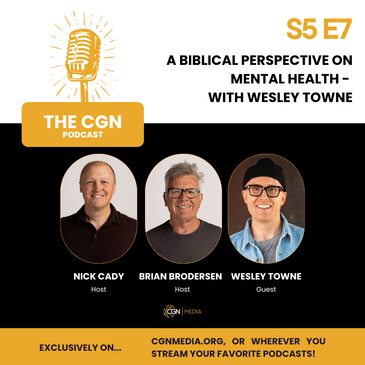


In this episode, Brian Brodersen & Nick Cady speak with Pastor Wesley Towne.
Wesley has planted two churches; he currently pastors Bayside Church in Davis, California, and he is the founder of Better Days, an organization seeking to bring hope and resources to those struggling with personal suffering and mental health.
In this discussion, Wesley shares with the story of struggling with anxiety as a young pastor, and how he found help from the Scriptures and from other Christians, as well as how he is now using what he learned to help others.
As a Calvary Chapel network, CGN is a global family of churches working together to proclaim the gospel, make disciples, and plant churches.
We would love to hear your feedback on these episodes; you can email us at CGN@calvarychapel.com
[00:00:02] This isn't something disconnected, detached from the Bible, but this is something embedded in the storyline of Scripture.
[00:00:09] People's mental and emotional struggles, it's not a modern concept, it's woven into the history of the Biblical story as a form of human suffering.
[00:00:22] Welcome to the CGN Podcast. My name is Nick Cady, I'm the pastor of Whitefields Community Church in Longmont, Colorado,
[00:00:30] and along with Pastor Brian Broderson, I will be your host this season.
[00:00:33] As a Calvary Chapel Network, CGN is a global family of churches working together to proclaim the Gospel, make disciples, and plant churches.
[00:00:43] In this episode, Pastor Brian and I speak with Pastor Wesley Towne.
[00:00:48] Wes has planted two churches, both in university cities. The church he currently pastors is Bayside Church in Davis, California,
[00:00:56] and he's also the founder of Better Days, an organization seeking to bring hope and resources to those struggling with personal suffering and mental health.
[00:01:06] In this discussion, Wes shares with us the story of his own personal struggles and how he found help from the Scriptures,
[00:01:12] and from other Christians, and how he's now using what he learned to help others as well.
[00:01:18] Here's the episode.
[00:01:22] Well, Wesley, thanks so much for being on the CGN Podcast today.
[00:01:26] Thank you for having me. Great to see you guys.
[00:01:28] And Pastor Brian, welcome.
[00:01:30] Yeah, great to be here. And it is so good to see Wesley.
[00:01:35] It's been a while since we actually connected, but here we are, right on, he's right on my screen.
[00:01:43] I'm loving it.
[00:01:45] Well, Wes, could you share a little bit about yourself? Where do you minister? What's been some of the journey up to that point?
[00:01:50] Yeah, I live in Davis, California, which is a college city, literally a college city.
[00:01:58] 40,000 students go to the university and a city of 67,000 people.
[00:02:04] So right now is graduation week, which means it's about to be a ghost town.
[00:02:10] So live here, wife, no kids, but we've got a little dog, Lucy, five pound, Chihuahua, Dachshund, Minpin.
[00:02:20] Oh my goodness. What does that even look like?
[00:02:24] Oh, little and fun and feisty.
[00:02:29] Wow. I guess they'd have to be feisty.
[00:02:32] You know, we have a golden doodle that weighs about 60 pounds.
[00:02:35] And I think the only dog that he's afraid of is a Chihuahua.
[00:02:40] Yes.
[00:02:41] Chihuahuas will always surprise them, you know?
[00:02:43] Yeah, they make themselves big.
[00:02:45] Yes.
[00:02:46] But this is my second church plant.
[00:02:48] I planted a church in 2008 when I was 26 years old in Eugene, Oregon, another college city.
[00:02:57] And that went amazing and incredibly challenging as well.
[00:03:02] Being that young, planting a church that grew quite fast.
[00:03:05] And I said, I'd never plant a church again.
[00:03:08] And here I am planting a church again in Davis, California.
[00:03:13] Very similar to Eugene.
[00:03:15] Wow. That's cool.
[00:03:16] So how is it going with the church plant?
[00:03:19] Yeah, it's going amazing.
[00:03:20] I think, I mean, as you guys know, when you do something a second time,
[00:03:26] you learn a lot from that first experience.
[00:03:30] And so being a little older, having the experience, making mistakes and growing from those,
[00:03:37] coming into the second church plant, I feel like I know a lot that I didn't know the first time
[00:03:43] that I'm able to implement, not just in like strategy or pastoring people or teaching the Bible,
[00:03:50] but even in the sense of like being healthy and knowing how to run the marathon rather than sprint.
[00:03:58] And how to have boundaries, how to invest in my own wellbeing so that I can thrive for the long haul.
[00:04:05] So that's been a really major benefit, you know, of having that experience for me in this second go around.
[00:04:14] And yeah, just, you know, I think it takes time for all of us to learn who we are and feel comfortable,
[00:04:22] like be in our pocket, so to speak.
[00:04:24] And I feel like when you're 26 and planting a church, you have no idea who you are.
[00:04:31] You don't know your voice.
[00:04:33] You don't know how to deal with a lot of situations or feel comfortable,
[00:04:37] not anxious, connecting with people where they're at in life.
[00:04:41] And I feel like, you know, now this time, I feel really comfortable with who I am
[00:04:48] and what God has created me to do and really leaning into those things.
[00:04:53] Yeah, that's great. I mean, that's, I can relate.
[00:04:57] I was 26 when I had my first church as a, you know, the senior pastor, the lead pastor.
[00:05:03] And then at 39, I planted another church.
[00:05:09] And exactly, it's like, okay, you know, I don't know everything, but I do know a few things now.
[00:05:14] Yes. I thought I knew a lot when I was 26.
[00:05:17] So, Wes, I know you also, in addition to pastoring,
[00:05:21] I know you have a podcast and a ministry called Better Days.
[00:05:23] Could you tell us about that and how did that come about?
[00:05:27] Yeah.
[00:05:27] So when I was church planting, 26, 27, 28,
[00:05:33] our church started with less than five people
[00:05:36] and grew to thousands of people within a few years.
[00:05:40] And during that time, I had no idea how to handle the pressures,
[00:05:45] dresses, demands, all the things that were coming at me that I was having to adapt,
[00:05:52] leading staff, managing a team.
[00:05:54] I just didn't have a framework of how to do that well and how to be well at the same time.
[00:06:01] So, I probably walked through three years of severe anxiety, panic attack,
[00:06:11] panic attacks on a consistent basis, burnout.
[00:06:14] Now, it got so bad that year four to five, every Saturday night, I was praying,
[00:06:25] God, I do not want to teach on Sunday because I know what it means to teach every Sunday.
[00:06:28] I feel like I'm in a blackout.
[00:06:30] I have a panic attack every Sunday.
[00:06:32] I'm feeling anxiety the entire day.
[00:06:35] And not just low level anxiety.
[00:06:37] I mean, high level just wrecked me every single Sunday.
[00:06:42] So, as I walked through that, I realized that I had heard a lot of like negative things about mental health
[00:06:50] health, or, you know, Christians should never struggle with this.
[00:06:54] Anxiety is a sin issue and so on and so forth.
[00:06:56] In my early Christian years, I didn't grow up in the church, but the first church I went to really carried on a lot of stigmas around mental health.
[00:07:04] Didn't encourage counseling or reaching out for help.
[00:07:07] There was a lot of negative viewpoints around, you know, mental health struggles.
[00:07:11] So, as I was walking through that, I didn't feel safe to talk about it.
[00:07:18] I felt like, man, I must be doing something wrong.
[00:07:21] Is there something wrong with me spiritually?
[00:07:23] Is there something wrong with me as a leader?
[00:07:26] Like this is, you know, some sort of default problem in my life.
[00:07:30] And so I just kind of walked through it in silence.
[00:07:34] Then I met with Wayne Cordero, who has become a mentor of mine.
[00:07:38] Wayne Cordero wrote the book, Leading on Empty, sharing his story of walking through multiple rounds of burnout, leading a church in Hawaii.
[00:07:47] And he helped me immensely.
[00:07:50] I took a sabbatical.
[00:07:52] I got well.
[00:07:54] And as I was reflecting, I thought I'd never want to experience what I experienced again.
[00:08:00] But what can I do to re-engineer my life?
[00:08:03] What can I learn?
[00:08:04] Went to an incredible Christian counselor.
[00:08:07] Walked through a lot of stuff over a long period of time with him.
[00:08:12] Talked to Wayne.
[00:08:13] Read his book.
[00:08:14] Reflected on my experience.
[00:08:17] Reached out for help just to gain wisdom from different people.
[00:08:20] And I realized that my experience was actually quite normal.
[00:08:26] But not a lot of leaders were talking about it.
[00:08:28] So I think that experience was kind of the impetus to start talking about it.
[00:08:33] I started sharing my story.
[00:08:34] I met with Brian multiple times and shared what I'd been walking through.
[00:08:39] And he shared some of his story with me.
[00:08:41] And I realized, oh my goodness.
[00:08:43] Like, there's not only so many young leaders who I knew experiencing similar things in the ministry.
[00:08:50] But there were a lot of older, more seasoned leaders who had also, in their younger years, at some point experienced some sort of deep, painful, mental, emotional suffering.
[00:09:05] So, because the church had been so silent for so long, I thought, oh, you know, I think I should at least do something.
[00:09:13] Tell my story.
[00:09:14] Share what I've learned.
[00:09:15] So I started a podcast.
[00:09:18] And the podcast grew.
[00:09:20] And then it, you know, it turned into writing and teaching and speaking at conferences.
[00:09:26] And we have a whole ministry called Better Days.
[00:09:29] And essentially what we initially wanted to do was change the narrative in the church.
[00:09:34] And by doing that, like my heart was, I want to change the narrative so that we can recognize that this isn't something disconnected, detached from the Bible.
[00:09:45] But this is something embedded in the storyline of scripture.
[00:09:48] Like, people's mental and emotional struggles, it's not a modern concept.
[00:09:53] It's woven into the history of the biblical story as a form of human suffering.
[00:10:00] So I felt like if we could bring the conversation into the church within the context of the Bible, then people in the church could see that this isn't something to be afraid of.
[00:10:14] Like, this is something that the heroes of our faith had, many of them have walked through in their own lives.
[00:10:22] And through that lens, we could change the conversation by giving a biblical, robust, helpful theology and practice around mental health within the church.
[00:10:32] So that's what we do.
[00:10:35] We podcast.
[00:10:36] We have a team now.
[00:10:37] We train churches, leadership teams, speak at conferences, teach at churches, have conversations like this that hopefully help people to recognize not only is it safe to talk about these things when you struggle,
[00:10:50] but it's also a part of the story.
[00:10:54] But it's also a part of the storyline of our faith, which gives us the courage to say, if Paul or Jesus or Job or so many, Jeremiah the prophet walked through deep mental and emotional suffering, then we have the permission to declare that and get help in community as followers of Jesus as well.
[00:11:43] So, yeah.
[00:11:45] Some form of sin that you're committing by being depressed or anxious or something like that.
[00:11:50] I mean, I feel like, and maybe you can tell me what you think, Wes.
[00:11:55] I feel like the church kind of collectively has moved a little bit beyond that now where people are recognizing, like you're saying, this is a real experience for lots and lots of Christians and lots of Christian leaders.
[00:12:09] But not only that, it is embedded in scripture, like you're saying.
[00:12:13] You know, I never really understood that until I was stricken with some of that stuff.
[00:12:18] And then I began to read reading in the Psalms.
[00:12:20] I felt like, wow, the psalmist had the exact same experience that I feel like I'm having.
[00:12:26] Or the Apostle Paul, you know, where he states something like press beyond measure above strength so that we despaired even of life.
[00:12:34] You're like, oh my gosh, the apostles, they had those kinds of struggles too, which was really a relief to find out that I'm not the only one.
[00:12:46] And then, of course, that doesn't even touch on church history and some of the stories that come down to us through many of the saints that suffered in these kinds of ways over the centuries that God helped.
[00:13:00] So, yeah.
[00:13:03] Yeah.
[00:13:03] What do you think are some common misconceptions about mental health that you've encountered in your work and in talking with people?
[00:13:12] I think Brian brought up some of the main ones that we heard for so long within the context of the church is if you're depressed or you're anxious, like there's something wrong with you spiritually.
[00:13:24] Like you're doing something wrong as a follower of Jesus.
[00:13:27] What was interesting about my story is when I had planted this church, like I was reading my Bible every day.
[00:13:34] I was praying.
[00:13:36] I was in good, healthy community.
[00:13:38] I was seeking out spiritual wisdom as our church was growing from people that I looked up to, that I knew.
[00:13:46] So, I kept thinking like I'm trying God, like I'm trying to do all of these things, but I'm still struggling with severe anxiety and panic attacks.
[00:13:58] And I realized there was nothing wrong with me.
[00:14:01] Like I wasn't doing anything wrong spiritually.
[00:14:05] I was dealing with immense amount of stress and pressure that I didn't know how to handle.
[00:14:11] I didn't know how to carry it well.
[00:14:14] And I think that, you know, for so long we will take segmented verses outside of the context of scripture as a whole and we'll make a doctrine around some, you know, mental health issue.
[00:14:26] Like do not be anxious about anything.
[00:14:29] People have read that verse and that's the only verse they know that talks about that.
[00:14:36] And they miss out on the fuller context of scripture where two chapters earlier, Paul says, I'm sending a coworker so that I may be less anxious in the same book, which is so intriguing.
[00:14:51] And then in 2 Corinthians 11, 28, when Paul gives his like biography of human suffering in ministry, at the end of it, he says, and above all else, my daily anxiety for the churches.
[00:15:04] Yeah.
[00:15:04] So you're like, how does that work out?
[00:15:06] Where one instance, Paul says, do not be anxious about anything, but two chapters earlier, he talks about his own anxiety.
[00:15:13] And that's not the only time in scripture he talks about his anxiety.
[00:15:18] So I think that sometimes we make a strong dogmatic statement about a human condition without looking at the fuller narrative of scripture.
[00:15:33] And we miss out on the broader context and storyline.
[00:15:37] And I think that's dangerous.
[00:15:38] But I do agree with Brad.
[00:15:40] I think that we in the church and whether it's teaching or leaders or people in churches have made so much progress in this conversation, partly because so many people have struggled.
[00:15:53] I hear all the time from, as I travel from people in their 50s, 60s, 70s, that have been walking with Jesus for a long time, that are deeply rooted in scripture.
[00:16:02] I came because of this subject, because my kids, my grandkids are struggling, and I want to try to figure out how to help them.
[00:16:12] So we're seeing this embedded into all demographics, like this human challenge.
[00:16:21] And it's affecting people that love God, whether it's them personally or their families.
[00:16:28] And so I think that we have to talk about it.
[00:16:31] We have to talk about human suffering and this particular facet of human suffering.
[00:16:36] I think there's something to, you know, it's almost like God, you know, the way he does things, he sends pioneers.
[00:16:45] You know, pioneers are people who they pave the way for other people.
[00:16:50] And like you're talking about your own experience, you went through that experience and realized that there was help.
[00:17:01] And so you sort of burned a trail in a sense, you know, you paved the path for others now to come along.
[00:17:08] And I remember in the years that I went through those kinds of things.
[00:17:12] And, you know, it's funny because you think about like depression or anxiety or panic, especially panic.
[00:17:18] My gosh, a panic attack is one of the worst human experiences there is.
[00:17:24] You know, it's just, you know, we throw those terms around.
[00:17:29] And I think people who have had real panic attacks, they know that this is like a frightening, frightening thing.
[00:17:36] This isn't something that you just blow off like, oh yeah, I had a panic attack today.
[00:17:40] You know, I was kind of nervous about this.
[00:17:42] But I think all of this to say, I think God leads people into these things.
[00:17:49] I think of Paul.
[00:17:51] Paul says to the Ephesians in chapter 3, verse 1, he refers to himself as the prisoner of Christ Jesus.
[00:17:58] And then he says, for the sake of you Gentiles.
[00:18:01] And I've often thought about, of course, Paul was literally in a prison.
[00:18:05] But I've thought about the prison I was in for years of this kind of struggle that we're talking about.
[00:18:11] And realizing that it was for God to reveal himself to me in ways that I hadn't known him.
[00:18:20] And then for me to help other people to make it through those types of seasons.
[00:18:27] You know, to be somebody who could say to someone battling.
[00:18:32] I'm talking to a friend right now who's had severe anxiety and panic.
[00:18:36] And it just hit him.
[00:18:37] He's 70 years old.
[00:18:39] Never had it in his life.
[00:18:40] Just came upon him out of nowhere.
[00:18:42] And, of course, his question is, am I ever going to recover?
[00:18:48] Am I ever going to be normal again?
[00:18:51] And I'm able, because of my own experiences, not to just pat him on the back and say, hey, it's okay.
[00:18:58] You know, let's pray and read these scriptures and everything will be fine.
[00:19:02] I'm able to say, hey, listen, I promise you, you're going to get better.
[00:19:06] But it's going to be a journey.
[00:19:07] It's going to take some time.
[00:19:09] And so, yeah.
[00:19:11] So well said.
[00:19:13] God sends us ahead of the flock.
[00:19:17] It's not a calling by choice.
[00:19:20] No, absolutely not.
[00:19:21] I would never have signed up for these things.
[00:19:25] Yes.
[00:19:25] But I mean, in so many ways, Brian, as you know, it forms us.
[00:19:29] It changes us.
[00:19:31] Like who I am today is so different than who I was before.
[00:19:37] And how I relate to people, how I teach and connect with people, how I think about what
[00:19:41] people are going through has been so transformative for me, my character, my nature, my interactions.
[00:19:49] Wow.
[00:19:49] Yeah.
[00:19:49] There's 2 Corinthians 1, right?
[00:19:51] Like you've received the comfort of God and now you're able to share it with others.
[00:19:55] Yeah.
[00:19:56] That's it.
[00:19:56] Totally.
[00:19:57] And I've often thought about, because as a result of my own experience, I've been able
[00:20:03] to have so much compassion and patience with people who battle with mental struggles.
[00:20:10] And I think for those people to just know that there's somebody who empathizes, that in
[00:20:19] and of itself is part of the hope and the healing that can come, you know, to know that
[00:20:25] somebody else has been here.
[00:20:27] I'll tell you who brought me through a lot of my deep depression, believe it or not, was
[00:20:32] Charles Spurgeon.
[00:20:33] And it was Spurgeon's autobiography because in his autobiography, he's telling his own
[00:20:40] story.
[00:20:41] And I'm reading Spurgeon's story and just thinking, oh my gosh, you know, this, I could
[00:20:46] be, I could have written this paragraph right here.
[00:20:48] This is me.
[00:20:50] And just being so thankful that this man decided to pin down not just the great victorious moments
[00:21:00] of his ministry, which of course, anybody who knows Spurgeon knows there were many of those,
[00:21:04] but he chose to pin the dark and difficult seasons as well.
[00:21:10] And it literally like saved me.
[00:21:13] And he talked about his experience a lot with his students, you know, his pastor's college
[00:21:18] and lectures to my students.
[00:21:20] Spurgeon's, when I came to Jesus, it took me a few years to go to a church because I
[00:21:26] didn't know going to church was really important.
[00:21:28] No discipleship, no direction.
[00:21:30] But when I started going to a church, a Calvary Chapel church, the first interaction with any
[00:21:39] spiritual giant was Spurgeon.
[00:21:41] I read his biography.
[00:21:42] I read lectures to my students.
[00:21:45] And I didn't like, at the time, I wasn't like, wow, I'm fascinated that Charles Spurgeon
[00:21:50] dealt with, you know, lifelong depression in his adulthood from 22 on.
[00:21:55] But then looking back, I remembered, this is one of the great heroes of the faith.
[00:22:00] I mean, he has influenced generations of leaders and pastors.
[00:22:05] And for his entire adult life, struggled with depression.
[00:22:10] So much so that he had to leave the pulpit for months at a time every year because of
[00:22:16] his health and his mental depression.
[00:22:19] Well, that leads to a question I was going to ask you, Wesley, is that I know that this
[00:22:24] current age has been sometimes dubbed the anxious age because it seems like more people are being
[00:22:30] diagnosed with like anxiety disorders, more kids, you know, especially young people claiming
[00:22:35] to have struggles with anxiety.
[00:22:37] Do you think there's something unique to our particular time that lends itself towards that?
[00:22:42] Or do you think that this is just something that's being more recognized now than it was before?
[00:22:47] I would say both.
[00:22:48] And I think it's more recognized.
[00:22:51] People feel safe to share.
[00:22:54] I think it may be in previous generations.
[00:22:57] It was more stigmatized.
[00:22:59] People were afraid to talk about it.
[00:23:01] And I think that goes along with the storyline of scripture.
[00:23:04] You know, if you read through the story of the Bible, like the one commonality between
[00:23:08] all these greats of the faith is human suffering.
[00:23:12] And I take mental health challenges.
[00:23:15] There's two sides of mental health.
[00:23:16] One is flourishing.
[00:23:17] That's the way God created us to function.
[00:23:19] Genesis wanted to.
[00:23:20] And the other part is suffering.
[00:23:22] And that's usually the way that we talk about mental health.
[00:23:25] So I think if you look at mental health suffering, this is human history, including, you know,
[00:23:33] all the generations alive today.
[00:23:37] And then on the other hand, I think we're in an interesting time.
[00:23:40] Like our cultural context, or some people use this term cultural moment, is so unique
[00:23:45] because from 2008 on, you've seen this rapid shift in culture based on the iPhone and then
[00:23:52] social media, all of that has had a huge influence on the well-being of people in our world.
[00:24:00] And not necessarily for the positive, right?
[00:24:04] Like anxiety has spiked statistically, especially amongst younger generations who are attuned to
[00:24:09] like technology and so on and so forth.
[00:24:12] But I also think beyond technology, you know, there's this new book, The Ancient Generation.
[00:24:16] I think it's number one book in America right now.
[00:24:19] And then he talks about the technological shift from 2008 on that has created some of this
[00:24:25] reverberation in culture and demographics that are struggling with mental health conditions.
[00:24:30] But beyond that, we've got to look at other things as well.
[00:24:33] The breakdown of the family.
[00:24:35] You know, you have a lot of trauma and detachment and relational disruptions at young ages.
[00:24:41] Like so many families just struggle.
[00:24:45] And you have multiple generations that may have grown up in broken homes that didn't know
[00:24:50] how to process pain and emotions or teach that to their kids.
[00:24:55] And so when you grow up and you're an adult, you just carry on what you know.
[00:25:02] You know, if your family didn't talk about it, you don't talk about it.
[00:25:05] If your family had deep trauma, but it was hidden, you tend to hide it.
[00:25:09] So I think you have a lot of different things collectively taking place at once that are
[00:25:16] creating kind of this rise, rapid rise statistically.
[00:25:20] People are talking about it, but you also have a lot of hurt, pain, dysfunction in our culture
[00:25:28] today.
[00:25:28] And I think we'll look back on this time just on the lens of technology and realize,
[00:25:33] oh my, we had no idea how detrimental the technological advancements as far as, you know, internet, social
[00:25:45] media were on the mental health of all of us, but particularly the younger generations in
[00:25:52] our culture.
[00:25:53] And I think that technology, like here's one example, technology has been a root cause of
[00:26:03] loneliness amongst the younger generations.
[00:26:07] UCLA is kind of the experts on, they have a whole loneliness like research department.
[00:26:14] The loneliest generations in American history are the younger generations currently.
[00:26:18] But think about how God created us to have incarnational, person to person, deep, transformational,
[00:26:28] meaningful relationships.
[00:26:30] The younger generations have social connections virtually, but they're not connected incarnatively
[00:26:40] with people, around people, talking about life, you know, feeling the presence of other
[00:26:46] people, person to person.
[00:26:49] And they tend sometimes to be anxious in those settings because there's so much social connection
[00:26:55] over, you know, digital means that they're not as comfortable when it comes to person to
[00:27:00] person relationships.
[00:27:02] And I think all of these things that are happening in culture, like just take that for example,
[00:27:08] the loneliness epidemic rooted in the technology shifts.
[00:27:12] The church is the answer.
[00:27:15] Like we have this beautiful thing called the church, the people of Jesus, communities following
[00:27:21] Jesus in relationship, providing deep, meaningful relationships that we can provide to a lonely
[00:27:30] generation, a generation that is feeling the void of something that God created us to flourish.
[00:27:38] Yeah.
[00:27:39] Yeah.
[00:27:39] And what do you think that churches can do?
[00:27:41] Like if you were going to give advice to churches, what would you say that we can do
[00:27:45] to better support individuals struggling with mental health issues?
[00:27:48] Yeah.
[00:27:49] I would say a couple of things.
[00:27:50] One, develop a really healthy theology of mental health in the church.
[00:27:55] Some of our writing and podcasting and such can help in that.
[00:28:00] And there's other resources as well.
[00:28:01] We're just one of many.
[00:28:03] I think that really helps because I think if you're going to change a subculture, because
[00:28:07] Christian communities are a subculture within a larger culture, you have to speak the language
[00:28:12] of that subculture.
[00:28:14] The language of Christianity is scripture.
[00:28:16] So if we develop a healthy theology and people realize this is in the pages of scripture,
[00:28:21] these are the people that I look up to.
[00:28:23] These are the stories that I've heard over and over.
[00:28:26] Then people tend to be comfortable and destigmatize the conversation within the church.
[00:28:33] So I'd say number one, develop a healthy theology.
[00:28:36] Number two, I think we all need to realize that majority of the people walking into our
[00:28:44] churches every Sunday are experiencing pain or dysfunction on some level.
[00:28:51] So I think developing a deep compassion, whether we're pastors or we're just people coming to church,
[00:28:57] like core members of the church, we need to realize that there is a soul level pain that most people
[00:29:08] are experiencing because we live in a fallen world.
[00:29:10] And life is hard and complex.
[00:29:13] And if we just develop a compassion or empathy, the term that you used, which is kind of an
[00:29:20] interesting word right now, like some forms of Christianity are like using it as a pejorative.
[00:29:26] But I see empathy as literally sitting with someone in their pain and experiencing it from their level.
[00:29:36] It's exactly what Jesus did in John chapter 11, where he went to the funeral of his friend,
[00:29:41] whom he resurrected, but as they were weeping, he wept, which is a beautiful picture.
[00:29:48] So I think that we need to just come into the church and realize one of our opportunities
[00:29:55] to evangelize and help our current culture is just to lean into people's pain and love them
[00:30:01] and to be a safe community for people to process their pain.
[00:30:06] And then I think third, something that has helped me immensely is to realize Jesus walked through
[00:30:12] all of this.
[00:30:14] Every form of human suffering Jesus walked through.
[00:30:17] When Isaiah describes Jesus, he said, he's a man of sorrows and well acquainted with grief.
[00:30:24] Two Hebrew words that are used for mental and emotional pain.
[00:30:28] And when Jesus was in the garden of Gethsemane, he sweat drops of blood.
[00:30:34] That's like a rare medical phenomena that's always associated with some sort of mental stress
[00:30:40] or anxiety or trauma in the ancient world.
[00:30:43] I just think it's fascinating that Jesus, like our ultimate hero, God, Savior, Lord,
[00:30:51] dealt with pain on every human level in order to relate to us.
[00:30:57] So I think in a evangelistic, redemptive way, we need to talk about that and how our Savior,
[00:31:06] that we talk to and we worship, understands everything that each of us is going through
[00:31:13] as far as a pain-suffering level, even to a greater degree than we'll ever experience.
[00:31:19] And I think when we frame Jesus as the safest relational home to process our pain, that's
[00:31:26] it.
[00:31:26] That's life-changing concept to have as a follower of Jesus, no matter where you're at in your
[00:31:33] faith, new Christian, older Christian, leader, to realize that Jesus is the most compassionate
[00:31:41] person that we can ever process our hurt and pain with.
[00:31:47] And I think that goes along, that aligns and parallels with the Psalms, like what Brian
[00:31:52] talked about.
[00:31:53] 40% of Psalms are Psalms of lament, which means 40% of the worship and prayers of the ancient
[00:32:00] people of God were lamenting over human suffering toward God.
[00:32:06] It was part of their relationship with God, part of their prayers, part of their worship.
[00:32:09] So I think if we can normalize that in the Christian space, in our context, in churches,
[00:32:17] I think that alone changes the conversation and gives people permission to bring those things
[00:32:24] to the church and to Jesus in a really healthy way.
[00:32:29] That's such a key word to permission, because I think that is what was not given for a long,
[00:32:37] long time.
[00:32:38] And still, in some cases, it's not really given.
[00:32:41] People feel that they can't be that vulnerable.
[00:32:46] You know, they can't share those things.
[00:32:48] They're going to be looked down upon.
[00:32:50] They're going to be thought less of or whatever the case.
[00:32:54] And I think, you know, as preachers too, even though I do think a preacher can overexpose
[00:33:03] themselves from the pulpit, I do think that we have to be honest and vulnerable and tell
[00:33:12] the truth about our own weaknesses and suffering.
[00:33:15] I mean, I can tell you guys, it has been so often the case that when I share my own story
[00:33:24] of the struggles that I've had in these areas, this is the most impactful for people.
[00:33:31] They would come to me afterwards and say, you know what?
[00:33:33] I just never imagined that somebody like you, meaning you're the pastor, you're the guy who
[00:33:39] teaches the Bible, you're the guy who knows everything.
[00:33:42] And that's their assumption, of course, but that you have gone through these things and
[00:33:47] you're like, well, yes, you know, I am a human being and this is the things that we go through.
[00:33:53] And I guess, again, with a permission thing, when you are vulnerable yourself, you are automatically
[00:34:00] giving people permission.
[00:34:02] They then realize, oh, I can talk about this.
[00:34:05] It's okay.
[00:34:07] Yeah.
[00:34:08] Yeah.
[00:34:08] On the lament level, I think that lament is something you can only really do if you have
[00:34:12] hope in God and hope that things are going to be different.
[00:34:15] It's not just moaning, complaining, griping, but it's saying that I know that things are
[00:34:21] meant to be a certain way and one day they will be.
[00:34:24] And yet they're not that way right now.
[00:34:26] And I'm grieving that.
[00:34:28] And yet I'm grieving as one who has hope.
[00:34:30] And I think that learning to do that is valuable.
[00:34:35] Is there any practical advice that you would give to someone?
[00:34:38] Maybe there's someone listening to this.
[00:34:39] Maybe they're a ministry leader who themselves is struggling with mental health struggles,
[00:34:45] maybe depression, anxiety, or something beyond that.
[00:34:48] Is there any practical advice that you would give to them?
[00:34:51] Yeah.
[00:34:52] I would say if you're a Christian leader and you're struggling with depression, anxiety,
[00:34:57] burnout, panic attacks, whatever your form of mental or emotional health challenges are,
[00:35:05] number one thing that you can do that will lead is to reach out to somebody and to talk about it.
[00:35:13] Burying our pain and our struggle only worsens our situation on every level, psychologically,
[00:35:19] mentally, emotionally, relationally.
[00:35:22] So the sooner that you can talk about it with somebody that's safe, that's trusted,
[00:35:27] the sooner you're going to be on the pathway to help and healing.
[00:35:34] So I'd say share with somebody, share with another pastor, share with a close friend,
[00:35:40] share with some people that you just know they love you, they care about you,
[00:35:44] and they want you to flourish and be well.
[00:35:47] And then don't be afraid to reach out for professional help.
[00:35:52] I think that has definitely been a stigma within Christianity, but I always say God gifts people
[00:35:58] in different ways to help people.
[00:36:00] God gifts people to be doctors or lawyers or professors.
[00:36:05] And certainly God gifts people to help people unravel the complexity of human suffering
[00:36:11] and give them tools, practical tools to help them navigate those challenges or triggers along the way.
[00:36:19] So don't be afraid to reach out for help.
[00:36:22] I had an amazing Christian doctor that Wayne Cordero linked me up with that has been so helpful to me.
[00:36:29] Now, a therapist isn't equated to be a savior.
[00:36:34] They're a tool that God uses.
[00:36:35] So I would say, as well as utilizing those tools and relationships, talk to God.
[00:36:42] Like, really be honest with God, like we see in the Psalms with what you're dealing with.
[00:36:48] God will provide spiritual strength, and he's an ever-present help in time of need.
[00:36:54] He can help you in ways that no other human being can help you.
[00:36:58] But we have to engage honestly with God.
[00:37:02] And I think when we do bring our hurt and our pain to God, he gives us a strength and hope and help in spiritual, resourceful ways that we absolutely need
[00:37:17] and that are vital for us to continue to follow Jesus and flourish in any way.
[00:37:21] So I would say that for Christian leaders, but I would say the similar things for Christians, right, as a whole.
[00:37:29] Like, churches should be the safest place and the most compassionate place for us to bring our real honest life story and struggles to.
[00:37:39] So find some safe people in your church context.
[00:37:43] Talk to Jesus.
[00:37:45] Don't be afraid to reach out for help.
[00:37:47] In fact, we encourage you to if you need it.
[00:37:50] And realize that Christianity is not a bunch of perfect people, right?
[00:37:55] We're not a museum.
[00:37:56] We're a bunch of humans trying to figure out how to follow Jesus in a broken world, and we all have pain.
[00:38:03] So me and Brian sharing our story, we just want to give you the permission that you should never feel shame for the pain that you're walking through.
[00:38:13] It is completely normal.
[00:38:15] We've been through it.
[00:38:16] We've walked through these seasons, and it's okay that you're walking through it as well.
[00:38:22] Do not feel bad about yourself spiritually because of what you're going through.
[00:38:26] That's so good.
[00:38:28] You know, one last thing.
[00:38:30] I was—a while back, I was asked to speak somewhere, and it was to pastors.
[00:38:36] And, you know, I was just thinking about the different things that you hear people say or maybe even read in books.
[00:38:45] Like, you know, what are the things that formed you?
[00:38:46] What are the things that—what do you think are the things that are really significant in making you into the person that God is making you into?
[00:38:57] And, you know, of course, pastorally, we're oftentimes thinking of effectiveness and efficiency and all of those positive things, you know.
[00:39:09] But seriously, as I sat and thought about it, I thought, you know, the most significant things in my life have been the suffering.
[00:39:15] Those are the things that God has actually used to shape me into who I am mostly.
[00:39:21] I don't know that that's that encouraging of a topic to share at a conference with pastors, but it is the reality, isn't it?
[00:39:31] I mean, this is—
[00:39:32] It's so true.
[00:39:33] Like you said, Wesley, this is the Christian life, but this is life in ministry too.
[00:39:38] And you don't have to look far into the life of Jesus, as you already mentioned.
[00:39:42] And his situation was a little bit unique, but yet the life of the apostles—I mean, you know, the word regarding Saul of Tarsus, I will show him the great things that he must suffer for my name.
[00:39:54] It's like, oh, wow.
[00:39:56] Okay, that's what we're signing up for here.
[00:39:59] Yes, count the cost, right?
[00:40:02] Yeah.
[00:40:02] Yeah, I mean, I agree.
[00:40:04] Like, I think you said this.
[00:40:07] I would never choose that path.
[00:40:11] Yeah, right.
[00:40:12] But I wouldn't change what I've learned from it and who I've become.
[00:40:17] It shaped me more than, like you said, more than anything as a pastor, a husband, a human, a follower of Jesus.
[00:40:25] Like, so profoundly changed who I am.
[00:40:28] And I'm so grateful for that.
[00:40:30] Yeah.
[00:40:31] Yeah.
[00:40:31] Wes, how can our listeners get in touch with you and follow your work?
[00:40:36] Better Days.
[00:40:37] We have a podcast on all podcast platforms, including the CGN website.
[00:40:42] So you could go there.
[00:40:44] And we have a website, Better Days F-M-L-Y, family, but short for family.
[00:40:49] Better Days F-M-L-Y dot C-O.
[00:40:51] And that has all of our resources and links to all of our podcasts.
[00:40:55] And we have video content as well.
[00:40:58] So if this would be of help, we'd love to be a resource to help you.
[00:41:03] Awesome.
[00:41:04] Well, thank you so much, Wes.
[00:41:05] Thank you.
[00:41:07] Yeah.
[00:41:07] Great to see you.
[00:41:09] Great to hear you.
[00:41:11] Great to glean from the wisdom that God has given you.
[00:41:14] And can't wait to see you in person one of these days.
[00:41:17] Yes.
[00:41:18] Great to see you, Brian.
[00:41:19] Look up to you.
[00:41:20] So value our friendship and deeply appreciate you.
[00:41:24] Thanks, Wesley.
[00:41:28] Thanks for listening to this season of the CGN Podcast.
[00:41:32] In our next episode, Pastor Brian and I will be speaking with Dominic Hernandez.
[00:41:36] Dominic serves as Associate Professor of Old Testament and Semetics at Talbot School of Theology.
[00:41:43] We'll be talking with Dominic about teaching the Old Testament as Christian scripture.
[00:41:49] New episodes are released every two weeks, so make sure you subscribe to the podcast
[00:41:53] so those episodes will be delivered to your device as soon as they come out.
[00:41:58] We'd love to hear feedback from you on these episodes.
[00:42:00] You can email us at cgn at calvarychapel.com.
[00:42:05] And if you'd like to support this podcast, one of the best ways you can do that
[00:42:08] is by giving us a rating and review on your podcast app.
[00:42:12] Until next time, God bless you.
Sponsors