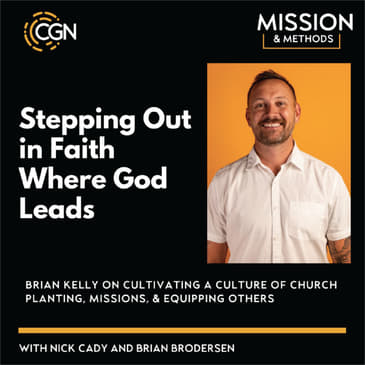

This season, on Mission & Methods, we are getting to know members of the CGN Executive Team.
Brian Kelly is the pastor of WestChurch in Bradenton, Florida. Prior to planting WestChurch, Brian and his wife Lynne spent several years as missionaries and church planters all over the world.
In this episode, Brian shares how God led him to places as diverse as Africa and New Zealand, and the blessings and challenges of ministering in those places. He also discusses the work he is currently doing with Cultivate to encourage and equip new church planters and missionaries, and what he’s excited about for the future of CGN.
We’d love to hear feedback from you on these episodes. You can email us at CGN@calvarychapel.com
[00:00:00] Welcome to the CGN Mission and Methods Podcast, Season 4. My name is Nick Katie. I'm the pastor of Whitefield's Community Church in Longmont, Colorado and I will be your host this season.
[00:00:11] The goal and vision of this podcast is that it would be a forum for communication about Calvary Global Network. We want to share with you some of the stories about what God is doing. We want to talk about some of the initiatives we're involved in spearheading,
[00:00:26] and we want to answer the questions you might have about who we are as a network. On the episodes in this season I'm joined by Pastor Brian Broderson, the founder and president of CGN and the pastor of Calvary Chapel in Costa Mesa, California.
[00:00:40] For Season 4 of the podcast, Brian and I will be interviewing the members of the CGN Executive team so you can get to know their stories, hear about their ministries and the roles they play in CGN,
[00:00:51] and find out what they're excited about for the future. In this episode, Pastor Brian and I speak with Brian Kelly. Brian is the pastor of West Church in Braitant and Florida. Prior to planting West Church, Brian and his wife Lynn spent several years
[00:01:06] as missionaries and church planters all over the world. In this discussion, Brian shares how God led him to places as diverse as Africa and New Zealand and the blessings and challenges of ministering in those places. He also discusses the work he's currently involved in,
[00:01:22] equipping and encouraging new church planters and missionaries with the Cultivate Initiative, and what he's excited about for the future of CGN. Here's the episode. Welcome to the mission method spotcast. This is Nick Katie and I'm joined today by Brian Broderson and Brian Kelly.
[00:01:37] Could we call you Brian? Which one's the greatest? Well, this is Brian. Brian Kelly's Brian the last. Did you do that? No, he dumped himself. He's a humble guy.
[00:01:48] Did you do that? No, we were sitting together and someone said Brian and we both looked and they said no, Brian, the greater. And you and your Brian, you were a student that wasn't you. Okay.
[00:02:00] Okay, so I'm here with Brian Broderson, Brian Kelly. On this season of mission and methods, we are interviewing the members of the executive team we want you, our listeners to get to know them, hear their hearts, hear about their experiences in ministry.
[00:02:12] And we want you to know what experiences they've had so you can connect with them and also so that you know who the people are who are leading this network of churches, as family of churches into the future. So Brian, welcome. We're glad to have you.
[00:02:26] Are you talking to me? I just kidding. Perhaps yeah, whoever wants to answer, I'm glad you're both here. Brian, the lesser Brian Kelly, tell us a little bit about your
[00:02:37] self, where you from, where you serve and tell us about the journey that God's led you on leading up to where you're at now. Okay, sure. Well, first of all, thanks for having me on the show, Nick in the Brian. I am, I'm from originally from California.
[00:02:50] I was born in San Luis, a baseball, but I was raised in New Mexico and went to Calvary Chapel, I was in the Lach, I was in the Lach, and I went to first move down to Marietta. And have been kind of a missionary church planter ever since.
[00:03:05] I married beautiful wife Lynn and three kids, Judah, he's 22 now. Who had just got engaged recently? I was wondering if you hear about that. You know, I think I did. Yeah. He did so he's working at a mission organization here in Florida.
[00:03:20] And to my daughter Julia, who got married a year and a half ago? I remember that. To Gavin and her helping us here at the church, we're in Braden, Tinslore, Da, then our youngest Leanna is she was not a big fan of Brian Broderson.
[00:03:32] But she is now. She is now. Yeah, yeah, she said she gave me a hug. Yeah. I feel so good. I bored the guilt of that misstep for so long. Yeah, you know. And well, that's part of my story here. Yeah, we can get to that.
[00:03:47] We can't wait. I mean, I usually have such a great relationship with young people. And I just, yeah, I just really really. You messed this one up. You messed it up. Yeah, I just felt thankful that I'm forgiven. All right.
[00:04:01] So tell us a little bit more and hopefully we'll hear the story. So we were missionaries in East Africa for 10 years. We were part of a church planting team in Compoli, Uganda. And I was 23. My wife was 22. And we moved over with I was 20. Yeah, 23. 22.
[00:04:19] We moved over with a one year old in Lynn was pregnant. And you know, we just felt like God was calling us there. We wanted to go on the mission field. I've had a heart for missions ever since Bible College. Missionaries would come and speak.
[00:04:31] And you know, you hear that. And that was something that we wanted to do. So we went to the team there and it's kind of a cool story. How we got there. But anyway, we were in Uganda for 10 years. And planted Calvert Chapel, Compoli.
[00:04:45] And that's still going strong. Pastor Zeti is there now. And we moved back from Uganda to San Diego are adopted sending church. We were sent out of a little church in Montana, but we were then later adopted. They were unable to support us and all that.
[00:05:04] But we were adopted by a maranatha chapel pastor Ray Bentley who they would come over every year. And he mentored me and kind of taught me what it was to be a pastor. I became the senior pastor that church, not first year that we were there.
[00:05:16] And so moved back to San Diego. I was a missions pastor there at Maranatha Chapel for three years. And we started the young adult ministry there as well called the bridge. And just really getting to sit under great Bible teaching.
[00:05:32] But I had a great time there in Pastor Ray who is with the Lord now. It was really a great. He's such a good example of just a kind. And you know, it was a mega church but just really personable and kind spirit filled guy.
[00:05:47] So we felt the desire to plan a church, you know, it's they would ask some of the other pastors on staff were like, You know, you've got a great job here. You've got a paycheck. You can kind of do what you want ministry wise.
[00:06:00] Why would you ever want to leave and start something new? But that's just kind of how we feel like we're wired is to do that pioneering stuff, church planting, and working.
[00:06:08] So we went up to Washington State, just north of Wayne Taylor and we went up there and connected with him. And planted the church and belly him, Washington, which is on the border with Canada. In the downtown area, it's very liberal place there, pretty dark place, spiritually.
[00:06:21] And physically, reigns all the time. But we planted the church there and we were there for four years. And that church is still going strong. Pastor JJ is up there doing an awesome job. You know, JJ. Yeah, I knew JJ when I was in high school.
[00:06:33] So we're just no workshop in Colorado. We had common friends in JJ was sponsored by Solomon, who's snowboarder. Yep. And so yeah, belly him is big, big skiing, snowboarding area. It is, yeah, mountain baker. Yeah. So that's one of the reasons why I loved it.
[00:06:47] I mean, it got kind of depressing up there though because of the rain and everything. But we were up there for four years and then church was going great. And JJ was there and some other guys were working together.
[00:06:56] And got a call from very, very good friend from Africa, Doug and Destiny, Calhoun, who were missionaries in East Africa at the same time. We were with Calhoun Chapel and they had gone to New Zealand to take over a Calhoun Chapel church there.
[00:07:11] And I made a joke like, you know, hey, because we want to come visit him. Everybody wants to go to New Zealand and visit. I know you love New Zealand. I do. And part of the bigger story here. Yeah.
[00:07:24] And you know, I always communicate with him, talk about him for us. And it was kind of like, we're going to come visit you one day. We got to get down there and I made a job.
[00:07:33] Remember texting him, I made a joke like, hey, if you hear of any churches that, you know, the pastor wants to retire or they need a new pastor down there. Let me know like, hello. So he's like, as a matter of fact.
[00:07:45] And he had been in conversation just that week before I made the joke, which he was in conversation with Brian Hughes who had planted the Calhoun Chapel Auckland in New Zealand 20 something years ago.
[00:07:57] And was looking for someone to come and, you know, take over the church and kind of take it in a new direction and we, you know, long story short. It's like, as a matter of fact, I do. I was just talking to someone.
[00:08:10] Can I have him call you? And then he called me and we talked on the phone for an hour. And he said, yeah, when can you come? Can you be here? You know, a few months.
[00:08:20] And so we prayed about it and everything and that seemed like that open door. And JJ, who had a desire to plant in Bellingham, he's a local guy, a Colorado and then up in Bellingham. But he took over the church there.
[00:08:33] We went to New Zealand and I became the senior pastor of Calhoun Chapel Auckland in New Zealand. We're there for two years only two years. We plan to be there much longer. We had a close friend of mine pastor and mentor.
[00:08:49] Tell me that it was God's will for me to stay there. Okay, let me jump into this. Yeah, so I do brand-huse was a good friend of mine as well. So I had already, you know, been to New Zealand a few times.
[00:09:02] You know, been with Brian and with the church. We did a radio network all throughout New Zealand and some of the islands in that part of the world. And so when Brian Hughes was retiring, I was just thinking, man, this church really
[00:09:20] needs, you know, it just really needed the right person. And when I heard that Brian Kelly was the guy I was so thrilled. I just thought this is going to be the greatest thing that could happen to this church.
[00:09:31] And sure enough, Brian went and God was really using him and the church was growing and the culture was shifting in a really good, you know, positive way. And it just seemed like man, you know, this, this is, this is just going to be,
[00:09:48] it's just going to get better and better. And then the pandemic, the pandemic, what happened right, I mean, that was that was kind of the nail in the coffin really wasn't it? Well, New Zealand shut down hardcore. Like they were hardcore. Really hardcore.
[00:10:03] They actually eradicated COVID in the middle of it for like six months. We were out, you know, doing whatever rugby games and everything in the rest of the world with shut down because it had been, oh, the orders were clot like literally could not come in or out.
[00:10:17] So during that time, your, your older kids had come back to the state. Yes, so Judah, our oldest was at Calvary Chapel Bible College. And Julia was also at our second oldest. She was 17 at the time almost 18. She was in the state.
[00:10:34] And so they were, they were in the states. And when they announced the borders were going to be shut, nobody can come in. We had work permits. We were, we had visas to be there and everything.
[00:10:44] But unless you were, so basically it was if you were a New Zealand citizen, you could only come in. If you paid $5,000 per person and went to a, a military guarded hotel for two weeks in state in your room as a quarantine measure. Like it was extreme.
[00:11:02] So even the population, the New Zealand population was not there were staying put. So we couldn't leave to go to the states and come back. If we left, we couldn't come back for who knows, who knew how long it ended up being you know, a long time.
[00:11:18] The majority of the pandemic like that. But, and then they couldn't come over to us, even though they were our children in the country. So we could not come in to the country. Literally was not allowed in, even though her parents were there.
[00:11:32] We would have to go with it to leave. Yeah, so all these dynamics were working and before it got to the, because I had just been there and not that long ago.
[00:11:43] And we'd, you know, been together and had a great time and just, you know, sort of talking about the future and what the Lord could do. That's some coffee. Yeah, we had a great time.
[00:11:54] And that, you know, fried so me and, and, you know, let's be honest, you didn't really want to leave either. Yeah, you know, I kind of thrived in New Zealand because it's culturally and we did a podcast
[00:12:08] episode with Bill Welles, you've planted in Australia and he told me something he said. It's deceptively similar. The culture is to America. I thrived there because Kiwis, that's the New Zealand people tend to be more reserved. They tend to be not so like outgoing or talkative.
[00:12:25] Like Americans are known for being, you know, loud Americans and, you know, talk with our hands and actually have fun and, you know, they have fun there. But I thrive there because I'm like an introverted person. I don't like talking to people that much.
[00:12:40] So I'm like, you know, all just nod to people in the road and be just fine. Yeah. My wife is very expressive and has kind of been a tallian, Lebanese background and her family is always loud at their house.
[00:12:52] And in a good way, you know, it's a really good positive trait of hers. Okay, she's listening right now. But it's, and then my daughter, Leona's like that too. So they didn't, she did not really click with the culture there. Very well, both land and Leona.
[00:13:08] And so it was a struggle and Leona in school and everything would get bullied a little bit because she was one of the teachers said she was some of the other teachers that's teacher was saying about her. Some of the other teachers find her, find her confidence offensive.
[00:13:26] Like she was too, you know, in an American we're like, you need to be the bad. You got to be confident and go get them. So it's just a different culture and not better or worse.
[00:13:35] It was just the way it was, it ended up being so as a struggle tough time. But I, I did love it there. I loved mountain biking. And so I had sort of beaches set to Brian like, I think you need to stay.
[00:13:49] You know, you need to press through this season. You, you know, God's difference. You can do it. Yeah, and boy, that just put me in the doghouse big time. You're daughter over her. Oh, she found out.
[00:14:01] Yeah, she'll be hurt and she found out and she was not happy with him. Yeah. She was ready to come back. How dare you? Being American again. She was like 15 at the time. You know, it was. But you patched it up.
[00:14:13] Well, you don't just like, yes, for today. Well, because it's like, I'm glad to hear how many years.
[00:14:18] So later, you know, maybe we were, we were meeting up Brian's house yesterday for, you know, a board meeting and she walked in on us and like, who are these strange? Yeah, she told me.
[00:14:29] And I was out of the room and what I walked in, she looked at me and her eyes got really big. She's like, oh, I can't cry out. What are you doing here? And I said, oh, great. Come on. You forgiven me right? So yeah, let's sweet.
[00:14:41] It was a sweet moment. That's good. She has gotten, she's grown so much in her faith too and just her. She's, I'll forgive him a long time. Oh, that's good. But maybe, maybe the time she was really, really well.
[00:14:54] But again, it was one of those things, you know, and obviously in the end, I was like, well, your family is a priority you need to do what you need to do. But and the Lord did an amazing thing with that church, right?
[00:15:07] You're, you're assistant who had come alongside early, a great young guy that we know, Jordan Walsh. The Lord raised up Jordan to take the church and he's doing his hesitant at first because he's a young guy and, you know, I believe,
[00:15:21] I saw the gift thing and he grew up in a Christian family and the ministry family. In Hungary. Yeah. I know the Welsh family of course, because they were at Calvary Bible College in Hungary. So they were doing the Bible College there in New Zealand.
[00:15:32] But Jordan came up and was the assistant pastor with me for a while. That's great. And became the pastor. Doing awesome. Yeah. So now you've come back to the US, then what, then what happened? I mean, we already told people are here in Florida.
[00:15:46] Yeah, yeah, we're here in Florida, Braden, to Florida, which is just south of Tampa. And this was a unique, I shared a little bit, we're a little gathering here right now. But I shared a little bit with the group last night that I really up to this point,
[00:16:00] I always kind of had an idea of what I wanted to do. I felt like God is calling us to do. Lynn is very instrumental in that. She hears from the Lord very clearly and, you know, direction and stuff too. So we work together on that.
[00:16:12] But you know, it's always been like, let's go to Uganda. There's an open door. Let's take it. Here's how we're going to get there and let's, and you know, just seeing the future, seeing kind of, having vision, that's what it is. Having vision to come back, you know,
[00:16:26] to work with Ray and to kind of be mentored, you know, to do mission work on top of that and get the travel and stuff. Yeah, it's a no-brainer. Planting the church in Washington strategized about it, you know, made plans, got a group together, you know,
[00:16:41] we're working with the cultivate church planting thing, you know, just kind of going through those steps of getting there. And making it happen. I mean, the Lord makes it happen, but we're following that leading.
[00:16:51] And then to New Zealand, the doors opened up and it's great opportunity, everything fits into place.
[00:16:55] You know, we see what could be, you know, you see a church that has such great potential that had, you know, was a great foundation built already and just taking off of that. And then, but then when this happened, it was like,
[00:17:08] I could just cut into the ideas that we had, the plans that we had. We had planned to be there much longer. And to come back to nothing in it, and I shared this that there wasn't my,
[00:17:20] I don't know if it was a vision or just an overwhelming feeling for a couple of weeks of just when I tried to see like what could the future hold, I just had a bling, like darkness. That's how I described it.
[00:17:33] You know, before you could kind of imagine what could happen, like where we could plan a church and what would be the people we reached? But when I looked, it was just like if you close your eyes right now and see that black, like nothing.
[00:17:46] And that doesn't mean there wasn't ideas that came into my head. You know, maybe Brian Broderson will hire me to work at just I did think about it. But he's the one that told me to stay in New Zealand. So you know, that was that burned that bridge.
[00:18:00] But then coming back, you know, we landed at, you know, my wife's parents living Las Vegas and then we say spent some time at my parents house just kind of praying through things, talking with people.
[00:18:12] Getting advice, but there was that real like hazy fog in front of us. There's no vision and I actually thought, I mean it sounds silly now, but I thought maybe my life is done.
[00:18:22] Maybe my ministry is done. I've been to Africa, planted churches, I've done mission work, I've worked at a big church, I've planted small churches, like been all over it. Maybe my what I've, and when I'm here for is finished. What did that happen?
[00:18:38] Did you do with the pandemic or was it? I don't know, I don't think at any thing that I don't know because the pandemic messed all of us up because we everybody was kind of like what's going on. Sure.
[00:18:48] Everything we kind of knew and were used to was changed. So I think that had something to do with it. Like maybe, you know, this is just the end. It smells kind of dark. Like you did all the things. I did it.
[00:19:02] Yeah, I got out of this and that's, yeah, you're finished. Maybe a little few years later. I finished it early and you know, it's like, okay. That's what you get for being an over a cheaper. Oh. And so what happened? How'd you get here in Florida?
[00:19:15] Yeah, so it's not over. Thankfully, I'm here still here. Still going strong. When we moved back, so when we planted the church in Washington, my brother and his wife came up with my brother's music and he played music and bars and stuff, you know, in Texas and Oklahoma.
[00:19:32] And he helped us. He would kind of had to come to the Lord moment through some things circumstances. Anyway, he helped us plant that church in Washington. And he said, you know, we're feeling like God wants to do something, you know, with us.
[00:19:47] Something different there in New Mexico at the time. If you come back and plant a church, we'll go with you anywhere you go. And I'll be the worship leader and I'll help you. I want to be a pastor. He was training in seminary to be a pastor too.
[00:20:00] And so I said, you know, I'm not really too excited about planting another church because, you know, as you know, Nick, it's not easy. It's not easy. And we didn't, I didn't have cultivate at the time.
[00:20:11] You know, it was just, you know, kind of do all the hard work and all that. So I thought, you know, if anything, I'd like to just maybe get a job at an at a church and kind of
[00:20:21] figure it out and kind of, you know, it's hard work. But then another couple from Colorado, on Jan, Josiah, they had, we've gone to Bible College with them 20 years earlier and they out of the blue kind of contact us, say, hey, if
[00:20:34] some reason we've been following you guys and what you've been doing in Africa and New Zealand and stuff and church planning in Washington, if you, we're feeling a call like, God's got something new
[00:20:43] for us, if you, if you decide to do like a church plant, we'll come and help you with that. You know, we can get jobs and just help you. And then at the same time, my wife's brother
[00:20:54] and his wife, their family, they were in California at the time and they were saying, we want to get out of California. Like, I don't know how much of a spiritual reason
[00:21:03] it was, but they're in the pandemic. You know, a lot of people want to get out of California. But it was a spiritual decision they made eventually, but they said the same thing, hey, you were thinking about going to this place in Florida called Anamaria Island,
[00:21:17] because she does stuff on Instagram and there with people that saying this is a kind of a hidden like gem in Florida on the Gulf Coast, run the Gulf Coast. And we're going to, there's an opportunity to buy a four unit in like an Airbnb type situation,
[00:21:32] but it's like rundown would you guys come out and pray about like, we went on a, like a trip with them to here, to bring tent to Anamaria Island. And would you guys pray about helping renovate that? Because I've got some construction
[00:21:48] and those kind of skills. Would you help us renovate that? What's it going, Lynn, who does real estate and that sort of thing? She can manage it for us. And we want to also help to contribute toward the start of a church plant.
[00:22:03] So again, it was like the third person that said, if you plan a church, we're going to help make it happen. So it was almost like, you know, all these things were happening and it was different for me
[00:22:14] because I didn't have the vision to do that or to create that or like, God, it's kind of like, you know, here's the visionary and he's going to get this crew around him.
[00:22:22] I was very reluctant to even go, but it was kind of like, we didn't have anything else and it seemed like God was doing something. Everybody else was the ones that had the, the heart and the passion. And I eventually did kind of, but we ended up here.
[00:22:35] We helped them renovate that end. We started meeting on the beach for Bible study. So it was, you know, we do the cultivate thing. We have all the steps and a lot of strategies for planting a church.
[00:22:46] But it was very organic in the sense that almost like those early days, you start starting your home and have a Bible study and it grows into a church. That's what happened. But it wasn't the home. It was the beach. We started on the beach.
[00:22:57] We still do meet on the beach now. So it's been two years now, almost to the day that we moved here. And so we started on the beach and then we got a building about a year and a few months ago
[00:23:09] and started Sunday morning services and people just loved the, because you mentioned today, Brian, there's a lot of churches in, you know, the south and here in Brighton. But people love the, our motto is kind of keep it simple like just stick to the basics
[00:23:25] and build relationships and teach the word and have good worship but don't go, you don't have to go over the top with everything. And it's been really refreshing and a lot of people have been connecting and love, love the ministry. Church is growing. Yeah.
[00:23:41] We had a huge two Easter services recently. So the cool. Yeah. And so here we are. We're doing a, we're doing a, love a gathering here. And I mean, I think if, if you didn't know and you just showed up here today,
[00:23:55] there's this great facility that we're in. It's just, you know, vibrant and life. And I mean, you think you'd been here 10, 15 years. Yeah. Yeah. You came here with nothing. And God just dropped all of this stuff in your life. Yeah. And it was almost frustrating along the way.
[00:24:15] I mean, we would sit together and talk with, you know, Dino. That's my wife's brother and my brother and Josiah. And we just kind of think about things and they're like, You know, we need to get a building and I'm like, well,
[00:24:27] you know, we can look around but I'm just, we're just kind of, it was just kind of relax a little bit. And we almost took, I wouldn't say too much time. It was just like things just came into place. It's hard to explain.
[00:24:39] It's really, it really is like this building, which is perfect for what we need. It's absolutely perfect. In a perfect location and everything, you know, through a mutual connection, you know, it used to be a Jewish synagogue this place. It's got around building and, um, seats about 250.
[00:24:57] And it has the, the out buildings where the children's ministry meet. And so this Iranian guy who lived in Germany. So onion Josiah speak German. She's from Germany. They end up talking to this guy in German. And he's, you know, talking about how he has, you know,
[00:25:14] you know, the market or anything because rental places, purchase places hard to find for churches, especially. But through this mutual contact, he's like, yeah, we have this place. There was a church that met there for a while, but really nothing came of it.
[00:25:29] And if you want to rent it, I'll rent it too. I don't have anyone put it on the market yet. So we did that. That's awesome. You know, there's something I've always thought like, this funny because like the first time we find a church,
[00:25:42] I felt like after it got off the ground, I was like, that was a miracle. Like some of those things that happened, you're talking about these connections that happened. And he's relationships and then this happens. And you're like, that was a miracle. And then I'm thinking about, okay,
[00:25:57] but if we start another one, like, I don't know if I can turn up on a miracle. Like I don't know. Yeah, I know. I think you know, there's no steps to that. It's not like, yeah. And so I don't know.
[00:26:07] But I think it's also just as you walk with the Lord, and as you follow his leading, it's really cool how you end up with now you've got. You've planted churches now on several continents, different parts of the US.
[00:26:19] And so maybe you can do is it called the Grand Slam? Because there they are there. You know, I really want at once on my had a vision to plan a church on every continent. But then I thought about Antarctica. I'm like, yeah, it's a continent.
[00:26:33] It wouldn't really. I'm kind of OCD, so if it didn't happen there, it's not really a continent. I mean, come on, it's an island. Yeah. Okay, so tell me a little bit about, okay, Ministry in Africa, Ministry in New Zealand, Oceania.
[00:26:49] And now on both coasts in the US, very different places even within the United States. How have these different context shaped the way that you think about? See the global mission of God and about church and ministry? Yeah, well,
[00:27:04] I've always thought that missionaries make the best church planters because you have to be able to go in and adapt to the cultures. You don't compromise on the gospel or anything like that, of course. But I feel like every place we go,
[00:27:18] one of the gifts that both Linda and I and our family, like our kids do have had is an ability to be kind of relatable to people. And that goes in Uganda. I mean, it took a while to learn there. But you know,
[00:27:32] we had people think about, oh, it must have been hard in Africa. But it really, in Uganda, Africa's not a country, it's a continent. So it's funny a lot of people say, Oh, you're in Africa, wow, it's a big country. Who's the president of Africa?
[00:27:45] There's so many different cultures in countries. And Uganda was is a Christian nation and, you know, it's very looks favorably, you know, towards Americans and that sort of thing. And speaks English. It's the national language. A lot of people don't know that.
[00:27:59] Everybody's first language is their tribal language. And there's dozens of those, but then their second language is the national, which is English, then East Africa is Swahili. So you can, you know, most everybody you talk to in the city speaks three languages,
[00:28:13] except for me I only speak one and a little bit of Espanol. So that didn't help. So having to, or getting to kind of learn and understand the culture in these different places is really beneficial. But also in seeing that there's similarities everywhere you go to.
[00:28:32] So I think that's what you're getting at as the mission of God and all these places is people are people or wherever you go. You, you have a cultural shell that they're living in, but they're, they're all, have all the same needs and desires.
[00:28:47] And it just manifests a little bit differently here and there. But finding that out is really strategic and figuring out how to meet those needs with Christ. That's the message that we have. So it's been really, I think good and I, I really appreciated the different cultures,
[00:29:04] especially in Africa and New Zealand, I could say too, which is a non-US culture. Believe me, Florida's a different culture too, as though. Especially from the Pacific Northwest. Oh yeah, that's a different culture too. I mean, that's extreme. Yeah.
[00:29:22] It's almost the opposite statistically of the Christians versus no religion to the rest of the United States where we were. So it was a different challenge altogether. But in places like Uganda and even New Zealand, but especially in Uganda,
[00:29:37] you discover what really is important about the Gospel and about our faith and what is kind of secondary or cultural baggage that we hold onto. And it's an advantage for people. I encourage people to get involved in missions,
[00:29:53] maybe not if they're going to go on the mission field themselves. But just to understand, like we as Americans are tend to be so, I'm trying to find a right word, not close-minded, but just short-sighted that we are the only ones that are matter,
[00:30:08] or that are the way we see our faith and the scripture and cultural issues. But when you start to live in other places, for example, in Uganda, some of our very closest friends besides the Uganda community, that we loved and ministered with and too,
[00:30:22] were other missionaries and expats. People that were there for business that were from England and all over Europe and different parts of America, Australia. And it opened our eyes to like, because we grew up in a very, well, I grew up in a very conservative kind of church.
[00:30:40] It was a church of Christ and New Mexico. No instruments and everything. It was a good church, good people. But a lot of rules tend to be a little bit legalistic. And then going into Calvary Chapel, which had, in my experience, had some of the unspoken rules.
[00:30:59] Like this is what we do and this is the people we do, hang out with as far as ministry wise. And this is who you don't. You'd go to the conferences, I remember going to the pastor's conference for the first time
[00:31:09] with a pastor friend of mine from Georgia. I was like, it was awesome because there were Bible teaching and stuff, but I tended to learn some other things that weren't so awesome about, you know, we're doing it right. And everybody else is doing it wrong.
[00:31:20] I think every denomination has it. But kind of going on the mission field and ministering with evangelical Anglicans and Presbyterians and Penicostals and those sorts of people that were, you know, ministering together for whatever project was happening. It was really eye-opening to see,
[00:31:38] the mission of God is bigger than our group. It's happening and we're going to get to have the advantage of contributing our, what we have to give. We have a lot to give to this bigger work of God that's happening in these places. So mission life really,
[00:31:57] that was one of the things that was the biggest eye-opener to me and it's like, wow. So some of our best friends, we just went and saw them in San Antonio, Texas, Bobby and Downey, Mickler, Presbyterian Church. And I remember hanging out with them
[00:32:11] and just kind of thinking, these are nice people to hang out with. But we're going to have to teach them a few things because, you know, do you do vers by vers? Do you have the caliber distinctives? Yeah. Okay, here you go. Yeah, be a real good talk.
[00:32:26] Yeah, but then discovering man, this guy's in many ways, like I'm learning, I'm leaning, I'm like seeing, wow, this guy really loves people and knows the word and all this stuff, and just eye-opening.
[00:32:42] And it was really good for me to see that we're part of a bigger picture. And so I think that's one of the biggest things. What would you say to somebody who's like, well, I don't know.
[00:32:53] I mean, like, I don't know if I can go move to Africa and learn how to be missional, so that I can come back to wherever I am. Where God has called me be. Like what would you tell them are some ways
[00:33:06] that they can learn those things or implement those things? Yeah, you're just going to have to go and do it. And some people have a gift to do that. All of us are called to be missionaries. I think that's what people just need to understand right away.
[00:33:21] There's a calling you have, and it's none of it's easy. But I think people would be surprised at what they could actually do if they tried. And that's one of the things that we learned early on is, you know,
[00:33:33] Lynn always describes it as having a little bit of faith and a lot of stupidity. You know, why are you going to move to Africa when you're pregnant and never one year old and don't have enough support?
[00:33:42] You know, because we feel like God's calling us to do it and kind of maybe a little bit dumb. Maybe we should wait, but, you know, we didn't wait and we did it and it worked out wonderfully. It was difficult.
[00:33:52] But I think people don't see what they're what's possible with the Lord. Because the Bible says that God uses the foolish things of the world. He uses the weak things of the world. He uses people that don't know what they're doing
[00:34:05] to be able to minister his power and grace to a world that is so prideful. And I think if you think you have a disadvantage to it, get training, I would say that first and foremost. If you say, what's one of the things I look back on
[00:34:19] is that I wish I would have done, get more training? Because it was kind of one of those things in the early days like if you get training or counseling or anything it's like you're not, you don't have faith. We got faith, watch.
[00:34:31] And then we made a lot of mistakes. I think I think almost everybody and Nick you went to. I mean, I met Nick. I don't know if you know this. I met Nick when he, I think he just turned 18. Yeah. So I met him in Hungary.
[00:34:45] He's 18 years old. He looks like he's 12 when he's 18. So I'm like who is this kid? Was he following us around for a first and from? I find out how he's there from Denmer and he's, you know. But, and you know, I was the person that kind of
[00:35:01] with the tip of the spear into a lot of the work in Eastern Europe. And we sent all of these people and, you know, all that we really thought you needed was a guitar and some stewcy clothing because we were being sponsored
[00:35:15] by stewcy and just making sure we were cool enough. Yeah. That of course we needed to know our Bible as well. But we didn't think for a moment about cultural adaptation. We could think like about language, what do you mean? We need to learn a language, you know.
[00:35:31] But then obviously everybody with hindsights at Honkji probably would have been a lot better had we met. You tell the little more preparation. Nick has one of those unique gifts. So he's in the country not too long and he's speaking fluent on Gary and so is that.
[00:35:46] I can't learn another language. I don't know what's wrong with that. I moved there when I was 12. So the cultural adaptation has not been very easy. Yeah. Not fair. You weren't. No, no, no, no. I was like, yeah, just look like I was 12 which helped.
[00:35:58] I fit in with all the middle school. I'm like hello fellow kids. You know that's Steve Buschammy. But the skateboard and the vaguer is that. I was in. But I don't think you brain. Unfortunately, I'm with you. I've been all over the world.
[00:36:15] I've been all these different countries. I've learned two or three words and all these different countries and forgotten all of them. Yeah, I was just in South America and I just kicking myself again and again. Like how many times have I been to Spanish speaking countries? Exactly.
[00:36:31] And I can say like like, I'm like audio. My best friend's dad growing up. I was at his house every day. Spoke only Spanish to him. You know, I took Spanish in the school. I've got a problem. But preparation preparation. I'm going back to that.
[00:36:47] I think there's you can actually do some things that are going to help you, whether it's mission work or church planting or any ministry. And don't be too prideful or listen to that noise that says, you know, that's not spiritual to ask for help.
[00:37:01] But one thing I would say too and I think this is where we've got a not only a great opportunity but in some some ways in obligation, especially if you're in a context socially
[00:37:15] where you've got a lot of diversity that you should seek to engage with those diverse cultures, rather than just being a homogeneous situation where like, okay, you know we're going to be like here we're surrounded with all of these, you know, maybe immigrant groups of people.
[00:37:32] Maybe they're even here for a few generations now. But we're going to kind of just be like a white person church. And we're not going to open the doors or seek to kind of understand or relate to. And there were those in Uganda when we were in Compollot,
[00:37:49] they were in the most. Yeah. I mean, yeah she like what? Why would you do that? When I was faster in London people used to ask me, do you have an American church in London? Yeah. Why would I have an American church in London?
[00:38:04] I go back to America and have an American church if I wanted to. Well speaking of the preparation thing, we'll wrap this up. We usually ask like what are you excited about for the future of CGN?
[00:38:13] I want to hear that, but I want to hear you talk about cultivate and the podcasts that you're doing with it. Great. Yeah, tell us and how was that fit into what we're talking about with preparation? Yeah.
[00:38:25] So I have been so blessed to be part of cultivate and you know it was sprung that invited me to this one of these vision meetings and said hey, why don't you sit over there with this guy Nick?
[00:38:34] I didn't know you at the time and you know you've planted a few churches. Why should you go over there and sit with them? And that kind of turned into me joining the crew of the vision that you and Kelly had kind of comprised of cultivate church planting.
[00:38:46] How to be more intentional within CGN, Calberate Chapel of Planning Churches? And we've got that goal of planning a thousand churches in ten years, which is doable and we did a podcast about that and Brian, you and I.
[00:38:57] But through that process of working together with you guys and strategizing about cultivate and church planting, I think it was you. I think it was you Nick that said, you know, we should do a podcast about this and I was like yeah,
[00:39:09] that's a good idea and you're like yeah, why don't you do it Brian? I've never done one before so I'm I'm I actually wanted to kind of try it. Yeah and so you're really good at it. Thank you. Yeah. I like doing it.
[00:39:22] I mean, I like you work with it. I think you did great. Oh thanks. Yeah and so definitely listeners please check out the Coltavae podcast. Brian has a bunch of great episodes with great guests and he's a very good host.
[00:39:34] And so yeah anything else that you're excited about in regard to the future of CGN? Yeah. I am excited. You know, thousands of churches just spreading out and the ministry that do Pastor Chuck in the different pastors and things but I feel like there's a new work
[00:39:52] of the spirit happening in our day today and within Calvary Chapel and Calvary Global Network. And now that I get I've always kind of been a participant, you know, church or you know, no have known you Brian and a few others but have never really been
[00:40:07] on the inside I guess of what's going on. But now that I get to be part of like doing these podcasts, cultivate and coming to some of these meetings and being on the executive team now now the more than ever I believe
[00:40:19] God is going to do a new and a fresh work with CGN. And I think that it's going to be a work of the spirit. I think it's going to be a work of church planting and I think it's going to be a fresh
[00:40:32] work that we haven't, you know, he's going to work in similar methods but not in the same way as he did in the past. And I think I'm excited about that and I think we need to hold on and get ready for that.
[00:40:46] So yeah, that's what I'm going to say. Amen. You're man. Thanks Brian. Yeah. Thanks for having me. Thanks for listening to this episode of the CGN Mission and Methods Podcast. In our next episode Pastor Brian and I will be speaking with Clay Whirl.
[00:41:00] Clay is the executive director of Calvary Global Network but prior to being in that position Clay was a missionary and a pastor in Ireland and then in the Bay Area of California. Clay will be sharing insights from ministering in those places and how it has shaped
[00:41:15] him and equipped him for his current role with CGN. New episodes are released every two weeks so make sure you subscribe to the podcast so those episodes will be delivered to your device as soon as they come out. We'd love to hear feedback from you on these episodes.
[00:41:29] You can email us at cgannacowraachapel.com and if you'd like to support this podcast one of the best ways you can do that is by giving us a rating and review on your podcast app.
[00:41:40] Written reviews are particularly helpful in helping boost this content so other people can find it and benefit from it. Until next time, God bless you.
Sponsors